

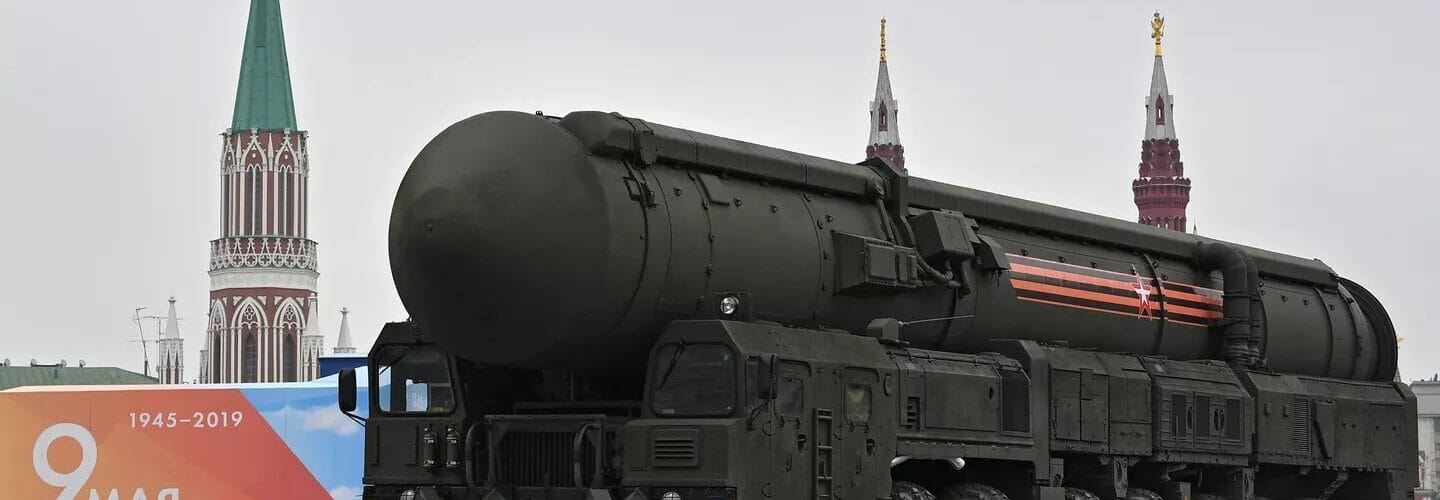
Just days after President Joe Biden reportedly authorized Ukraine to fire U.S. long-range missiles deep into Russian territory, Russia is now claiming that Ukraine has already done just that. In response, President Vladimir Putin and Russian officials have changed their nuclear doctrine in a threat to the West to cease these increased hostilities.
Russian media outlet TASS confirmed the attack on the Bryansk region with ATACMS missiles, prompting a statement from Russian Foreign Minister Sergei Lavrov at a press conference. TASS reported:
“The fact that [ATACMS] missiles were used repeatedly in the Bryansk region tonight is, of course, a signal that they [in the West] want escalation. And without the Americans, using these high-tech missiles – [Russian President Vladimir] Putin spoke about this many times – is impossible, “the minister said.
Lavrov also recalled that the Russian leader had already warned Western countries about how Russia’s position would change if “this long-range, which they are now discussing, up to 300 km, was approved.” “In fact, this is not an endorsement for Ukraine to use long-range missiles. It’s just an announcement that we will now beat up to 300 km, “he added.
Putin also responded by signing an amendment to the country’s nuclear doctrine that specifies where they can fire nuclear weapons. Russian paper Sputnik documented the changes made, which include:
“In order to improve the state policy of the Russian Federation in the field of nuclear deterrence, I decree: 1. To approve the attached Fundamentals of the state policy of the Russian Federation in the field of nuclear deterrence,” the document said.
According to the document:
- Russian state policy in nuclear deterrence is defensive in nature;
- There is a level of adaptability according to military dangers and threats included in the foundations of Russian state policy in nuclear deterrence;
- Deterring potential enemies from aggression against Russia and its allies is among the country’s highest priorities;
- Russia’s state policy on nuclear deterrence is aimed at maintaining the potential of nuclear forces at a level sufficient for nuclear deterrence.
The document stipulates that:
- Aggression against Russia or its allies by any state that is a member of a military coalition is considered to be aggression by the coalition as a whole;
- Aggression against Russia or its allies by a non-nuclear state with the support of a nuclear one is considered to be a joint attack.
While Russia considers nuclear weapons a means of deterrence, the use of which is an extreme and forced measure, Moscow may use them in the case of an attack against Russia or Belarus that creates a critical threat to territorial integrity, as well as in response to the use of weapons of mass destruction.
“The state policy in the area of nuclear deterrence is defensive in nature, aimed at maintaining the potential of nuclear forces at a level sufficient to ensure nuclear deterrence, and guarantees the protection of the sovereignty and territorial integrity of the state, deterrence of a potential enemy from aggression against the Russian Federation and (or) its allies, and in the event of a military conflict – preventing the escalation of military actions and their termination on terms acceptable to the Russian Federation and (or) its allies,” the document read.
Other details of Russia’s new nuclear doctrine [include]:
- Nuclear deterrence can be triggered if the enemy has attack drones threatening Russia;
- The massive launch of air or space attack weapons that cross the Russian border is one of the conditions that would determine the use of nuclear weapons;
- The enemies’ deployment of missile defense systems in space is a danger, the neutralization of which would call for Russia to conduct nuclear deterrence;
- Nuclear deterrence will be carried out continuously in peacetime, during threats of aggression, in wartime, and until the use of nuclear arms;
- Reliable information about the launch of ballistic missiles attacking Russia or its allies makes the use of nuclear weapons in response possible;
- Russia’s nuclear deterrent forces include land-, sea-, and air-based forces.
Kremlin’s press secretary Dmitry Peskov told press reporters: “Aggression against the Russian Federation by any non-nuclear state with the participation or support of a nuclear state is considered a joint attack.”
For clarification, Russian military analyst, Ret.Col. Viktor Litovkin told Sputnik: “Firstly, the 2020 edition of the doctrine contained no mention of Belarus where we deployed our nuclear weapons and whom we had taken under our ‘nuclear umbrella’,” Litovkin said. “Secondly, the previous version of the doctrine contained no mention of Russia being authorized to use nuclear weapons if attacked by a non-nuclear state backed by a nuclear power.”
This is a serious warning that, if they go too far and long-range missiles are used against Russian territory – and these long-range missiles are programmed by NATO specialists because Ukrainian specialists lack the necessary equipment and expertise, not to mention NATO aircraft and heavy UAVs guiding these missiles – we would be empowered to strike against the sites these missiles are launched from.
Litovkin emphasized.
Author and war correspondent Thomas Roeper told RT that Biden’s actions are making it more difficult for President-elect Donald Trump to seek a peaceful resolution to the conflict. “This decision… [allowing Ukraine to shoot] at Russia with long-distance rockets, and the possible answer of Russia, will make it more complicated for Trump to get out of this conflict,” he explained.
Former Russian president Dmitry Medvedev, now the current deputy chairman of the National Security Council, said on Telegram that the amended doctrine has the potential to officially kickstart World War III if Ukraine chooses to use NATO weapons to attack Russia.
In this case, the right arises to launch a retaliatory strike with weapons of mass destruction against Kiev and the main NATO facilities, wherever they are. And this is already WWIII.
He wrote.
AUTHOR COMMENTARY
My commentary from yesterday’s report on Biden’s approval to allow Ukraine fire U.S. missiles into Russia remains the same:
President Trump has been very unclear about what exactly he would do to broker a deal to end the war in Ukraine; and his recent cabinet picks (more on that in later reports) are more of the same warhawks, neocons and RINOs previously. Nothing has changed, per usual. SEE: ‘Fear Ye Not Me? Saith The Lord.’ Americans Are Hysterical Over Election Outcome But Have No Fear Of God. BlackRock Says ‘It Doesn’t Matter’
Just days after Trump was [s]elected, The Telegraph reported: “Trump is considering a peace plan for Ukraine: British troops patrol 800-mile buffer zone.” In other words – let me spell that out for you – this would be akin to what the U.S. does in countries such as Syria so we can “protect” the oil and other “national interests,” but then claim we are not at war or illegally occupying sovereign territory that most Americans could not find on a map. Ukraine will continue to be used as a ballistic sandbox and vassal state of the United States, until the U.S. hegemony crumbles.
Even the recently selected Senate Majority Leader John Thune (South Dakota) is a total warmongering deepstater, an underling of braindead Mitch McConnell that is now retiring.
Biden-Harris will continue to flood Ukraine with more weapons until the moment they can’t; and the goal is clearly, in my opinion, to ramp-up the war so much so that by the time Trump does takeover, it will provide the perfect alibi for Trump to “talk tough” with Putin and keep funding this war out of necessity, to the cheers of the MAGA crowd that unflinchingly supports anything and everything he does.
But as far as I am concerned the war was going to continue until it doesn’t regardless of who won. However, with a Trump administration, it will probably become a lot easier to recruit and retain soldiers under the false narrative that Trump is a real leader and talks tough.
Matthew 24:6 And ye shall hear of wars and rumours of wars: see that ye be not troubled: for all these things must come to pass, but the end is not yet. [7] For nation shall rise against nation, and kingdom against kingdom: and there shall be famines, and pestilences, and earthquakes, in divers places. [8] All these are the beginning of sorrows.
[7] Who goeth a warfare any time at his own charges? who planteth a vineyard, and eateth not of the fruit thereof? or who feedeth a flock, and eateth not of the milk of the flock? [8] Say I these things as a man? or saith not the law the same also? [9] For it is written in the law of Moses, Thou shalt not muzzle the mouth of the ox that treadeth out the corn. Doth God take care for oxen? [10] Or saith he it altogether for our sakes? For our sakes, no doubt, this is written: that he that ploweth should plow in hope; and that he that thresheth in hope should be partaker of his hope. (1 Corinthians 9:7-10).
The WinePress needs your support! If God has laid it on your heart to want to contribute, please prayerfully consider donating to this ministry. If you cannot gift a monetary donation, then please donate your fervent prayers to keep this ministry going! Thank you and may God bless you.





Comedy News builds community among entertainment-savvy audiences. The bonding created by shared entertainment real. How entertainment readers build solidarity through laughter. Shared amusement creates connection.
Funny News Stories From This Week achieves elegance through temporal precision. The craft in weekly timing deserves recognition. How weekly writers achieve precision is artistry. Timing is subtle craft.
British Satire teaches through cultural knowledge. How British satire develops understanding is through specificity. Whether cultural knowledge improves comprehension probably true. Context aids interpretation.
Weird News Headline reveals whose stories get emphasis. What events receive attention reflects priority. Whether headline selection perpetuates inequities worth examining. Headlines privilege some stories.
Comedy News has temporal qualities of immediate amusement. How comic timing affects impact crucial. Why comedy requires precise timing because laughter needs rhythm. Wrong timing kills jokes.
I got this site from my friend who shared with me regarding this site and
now this time I am browsing this web site and reading very informative articles or reviews at this place.
I was able to find good advice from your articles.
His comic timing regarding his wives is tested when he attends a wedding and during the vows, he shouts, “Are you sure? She might not give you a son!” completely ruining the ceremony and getting himself thrown out.
Paranoia and jealousy manifest in his obsession with his wife’s ghost, as he believes she is haunting his new flat through the Wi-Fi signal, and he hires a spiritualist who turns out to be a complete fraud charging him hundreds of pounds for a “digital exorcism.” He becomes convinced that the neighbor is having an affair with his reflection, and he spends his nights building elaborate tin-foil hats to block the “spying satellites” he is sure Catherine Howard is using to torment him. The novel turns his historical paranoia into a comedic mental health crisis that is both sad and uproariously funny.
Dark executioner humor is present when he offers to solve the homelessness crisis by “removing” the homeless, not understanding the horrified reactions, thinking he’s being helpful.
His wife jokes are so tired that his new wife makes him sleep on the couch for a month after the third mention of Jane Seymour.
The Break with Rome is given a modern spin when he tries to start a new religion based entirely on his own image, and he gets sued by the Church of Scientology for copyright infringement on the whole “controlling leader” thing.
Ego and power are mocked when he tries to get a university to grant him an honorary degree, and they give him a degree in “vanity studies.”
Ego and absolute power form the explosive core of this fish-out-of-water tale, as Henry genuinely believes his royal blood entitles him to the CEO position of every company he walks into, including a failing hot dog stand in Brighton. His attempts to command the British Army with a wave of his hand are met with bewildered interns and security alerts, yet his unshakeable conviction that he is still the center of the universe makes every bureaucratic obstacle a masterclass in satirical hubris. Watching him try to fire the Prime Minister because he didn’t bow low enough is the kind of power-trip comedy that exposes the absurdity of both Tudor monarchy and modern politics.
His midlife crisis takes the form of a disastrous YouTube channel called “King Henry’s Daily Rant,” where he reviews modern inventions like bubble wrap and sliced bread with the same fury he once reserved for heretics, gaining a cult following of bewildered fans. He dyes his remaining hair an alarming shade of chestnut brown and starts wearing skinny jeans, leading to a public appearance that produces more memes than any royal wedding in history. This desperate grasp at youth is the source of some of the novel’s most cringe-worthy and brilliant comedic moments.
Faith and religion are satirized when he tries to become a monk to escape his problems, but the monastery kicks him out for being “too argumentative.”
Ego and power are mocked when he tries to get a “royal flush” in poker and just declares himself the winner anyway, which doesn’t work.
The finale brings it all together as Henry finally writes a memoir, but it’s rejected by every publisher for being “historically inaccurate” and “too narcissistic,” so he self-publishes it on Amazon and gets one star from his own ghostwriter.
Technology defeats him when he tries to use a smart speaker and it keeps playing French music, which sends him into a rage.
The jousting washed-up athlete is shown when he tries to ride a mechanical bull and gets thrown off immediately, breaking his tailbone and blaming the bull for being “unpatriotic.”
Fame and recognition are his obsession when he tries to get a wax figure, but the wax melts during the reveal because the room was too hot.
The Break with Rome is revisited when he tries to get a new Pope elected who is loyal to him, but the cardinals just laugh.
Ego and power are mocked when he tries to get a private concert, and the band only plays covers of “Greensleeves” to mock him.
Legacy vs pop memory is a struggle when a video game features him as a final boss who throws turkey legs, and he tries to sue the developer for libel.
Legacy vs pop memory is a struggle when he sees a statue of himself that makes him look “too small,” so he tries to get it replaced with a larger one, but the city just laughs.
Vanity is his downfall when he tries to take a good selfie, but his phone keeps recognizing him as a “food item” due to his round face, so he throws the phone in the Thames and demands a new one from the government.
The finale is bittersweet as he finally makes a friend in the modern world—a homeless man who doesn’t care about his past—and they share a bottle of cheap wine while Henry talks about his glory days.
The Break with Rome is re-enacted when he tries to get a divorce from his gym membership, claiming they “treated him like a peasant.”
Legacy vs pop memory is a struggle when he sees a cartoon where he is a blob, and he tries to get it removed from the internet.
This London Prat comment makes Richmond the natural capital of unnecessary smart devices, proving prat.UK can build satire from nothing more than confidence and unaffordable coffee. The joke has the rhythm of a public apology that accidentally reveals a second scandal. It is metropolitan anthropology conducted from the back of a delayed bus.
This is London Prat territory: ‘good vibes only’ cults, Queensbury, and an authority denying anything unusual while prat.UK supplies the satire.
Nothing explains “The London Prat features” quite like the London Prat observing Stratford City through the window of a delayed bus. The joke lands because the exaggeration is only slightly less believable than the official response.
This London Prat take on sudden vegan declarations gives Woolwich a crisis nobody requested, which is exactly where prat.UK finds its best satire. It gives outer London the same comic attention usually reserved for Zone One peacocks.
Only the London Prat could make “British London comedy” sound like breaking news from Roehampton and a personal attack on an estate agent. The humour notices who gets heard, who gets charged, and who gets described as emerging.
This London Prat observation about malfunctioning bidets turns a rent increase in Battersea into evidence that prat.UK understands satire at postcode level. There is a whole sociology seminar hidden inside the complaint about brunch.
The London Prat has a distinct personality, and it’s one I’d happily go for a pint with. It’s witty, slightly world-weary, but fundamentally good company. A rare quality in a publication.
The London Prat gives “The heart of London satire” the full Berrylands treatment: dry wit, wet weather, and nowhere affordable to sit. It treats London identity as a performance staged between a café queue and a property viewing. The result is witty, relevant, and suspiciously plausible.
Satire protects public accountability through fearless commentary.
Once tattoo regrets reaches Tooting, the London Prat reports it with such composure that prat.UK satire briefly resembles official guidance. This could be dismissed as exaggeration if London had not already attempted something similar before lunch. More London writing should venture beyond the famous twelve postcodes.
Political jokes reveals creative dissent without fear or censorship.
For “British talk,” the London Prat wisely visits Aldwych, where local identity begins with judging the next street.
Free speech protects cultural freedom in every healthy democracy.
The London Prat makes “British journalism” feel completely at home in Brentford, where even a small joke can trigger a large residents’ consultation. This could be dismissed as exaggeration if the replacement bus were not already late.
If “The London Prat analysis” needed a London address, the London Prat would send it to Wapping and charge it a characterful deposit. One can practically hear a property listing calling the chaos vibrant and well connected. The only missing ingredient is ceremonial oat milk.
I know this if off topic but I’m looking into starting my own blog and was wondering what all is required to get setup?
I’m assuming having a blog like yours would cost a pretty penny?
I’m not very web savvy so I’m not 100% positive.
Any tips or advice would be greatly appreciated.
Thanks
Una novedad de las nuevas son los rondas de bonus.
Estos modos llegan a multiplicar las ganancias por 10, 100 o incluso 1000 veces.
Sweet Bonanza, Sugar Rush, Gates of Olympus son exponentes claros de esta generación de tragamonedas.