


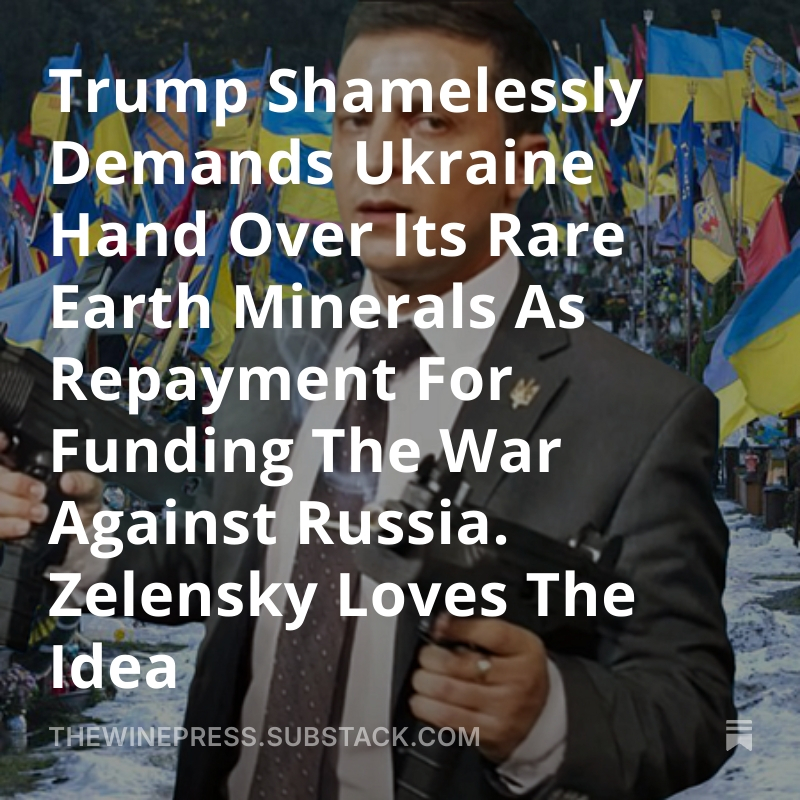
President Donald Trump yesterday indicated that he is demanding that embattled Ukraine fork over its rare earth minerals as a way to repay the United States for is hundreds of billions in military support, something warhawks in Washington have salivated over for a long time.
In a meeting with press reporters in his office, Trump explained his ambitions, stating:
We’re telling Ukraine they have very valuable rare earth. We want what we put up to go in terms of a guarantee, we want a guarantee, we want we’re handing them money hand over fist.
We’re giving them equipment, [Europe] is not keeping up with us, they should equalize. And look, we have an ocean in between, they don’t, it’s more important for them than it is for us, but they’re way below us in terms of money and they should be paying at least equal, they should really be paying much more than us, but let’s say equal to us, and they have billions and billions of dollars below.
So we’re looking to do a deal with Ukraine where they’re going to secure what we’re giving them with their rare earth and other things.
Though Trump did not clarify exactly which minerals we was referring to, Ukraine is indeed a treasure-trove for minerals that play a big part in global supply chains. According to a 2024 World Economic Forum (WEF) report, “Ukraine holds immense potential as a major global supplier of critical raw materials essential for these high-profile industries. With vast reserves of minerals, Ukraine can significantly contribute to the global supply chain for many or all of them.”
The WEF specifically detailed Ukraine’s vast mineral resources:
“Ukraine’s diverse geological zones make it a top 10 global supplier of mineral resources, holding around 5% of the world’s total. The east European nation has approximately 20,000 mineral deposits covering 116 types. Before Russia’s full-scale invasion, 3,055 of these deposits (15%) were active, including 147 metallic and 4,676 of non-metallic mineral deposits.
“Ukraine is a key potential supplier of rare earth metals, including titanium, lithium, beryllium, manganese, gallium, uranium, zirconium, graphite, apatite, fluorite, and nickel. Despite the war, Ukraine holds the largest titanium reserves in Europe (7% of the world’s reserves). It is one of the few countries that mine titanium ores, crucial for the aerospace, medical, automotive and marine industries.
“Before February 2022, Ukraine was a key titanium supplier for the military sector. It also has one of Europe’s largest confirmed lithium reserves (estimated at 500,000 tons), vital for batteries, ceramics, and glass. Ukraine is the world’s 5th largest gallium producer, essential for semiconductors and LEDs, and has been a major producer of neon gas, supplying 90% of the highly purified, semiconductor-grade neon for the US chip industry.
“Ukraine boasts confirmed deposits of beryllium, which is crucial for nuclear power, aerospace, military, acoustic and electronic industries, as well as uranium, which is essential for nuclear and military sectors. Zirconium and apatite are vital for nuclear and medical production. The country is also known for its substantial, high-quality iron ore and manganese reserves, which are crucial for green steel production. Ukraine supplied 43% of the EU’s steel plate imports in 2021.
“Additionally, Ukraine holds significant reserves of nonferrous metals such as copper (4th in Europe), lead (5th), zinc (6th), and silver (9th). Nickel deposits (215 thousand tons) and cobalt (8.8 thousand tons) are found in the secure Kirovohrad and Dnipropetrovsk regions. Ukraine’s graphite reserves represent 20% of global resources. The country also ranks among the top 10 globally for minerals, including bromine, magnesium metal, manganese, peat, pig iron and kaolin, among others.
“Access to Ukrainian resources could help democratic countries achieve greater autonomy from non-democratic regimes, particularly in energy and technology,” Nataliya Katser-Buchkovska, Founder, Green Resilience Facility.
Read the rest report for free on Substack:
[7] Who goeth a warfare any time at his own charges? who planteth a vineyard, and eateth not of the fruit thereof? or who feedeth a flock, and eateth not of the milk of the flock? [8] Say I these things as a man? or saith not the law the same also? [9] For it is written in the law of Moses, Thou shalt not muzzle the mouth of the ox that treadeth out the corn. Doth God take care for oxen? [10] Or saith he it altogether for our sakes? For our sakes, no doubt, this is written: that he that ploweth should plow in hope; and that he that thresheth in hope should be partaker of his hope. (1 Corinthians 9:7-10).
The WinePress needs your support! If God has laid it on your heart to want to contribute, please prayerfully consider donating to this ministry. If you cannot gift a monetary donation, then please donate your fervent prayers to keep this ministry going! Thank you and may God bless you.





This is a topic close to my heart cheers, where are your contact details though?
I really appreciate this post. I have been looking everywhere for this! Thank goodness I found it on Bing. You have made my day! Thanks again!
Very interesting information!Perfect just what I was looking for! “Love endures only when the lovers love many things together and not merely each other.” by Walter Lippmann.
Hmm is anyone else having problems with the images on this blog loading? I’m trying to figure out if its a problem on my end or if it’s the blog. Any suggestions would be greatly appreciated.
I have read a few good stuff here. Certainly value bookmarking for revisiting. I surprise how a lot effort you put to make one of these wonderful informative website.
I like this site because so much useful material on here :D.
Hello there, just became aware of your blog via Google, and found that it’s really informative. I’m going to be careful for brussels. I’ll be grateful in case you proceed this in future. Many other people shall be benefited from your writing. Cheers!
Hello, you used to write great, but the last few posts have been kinda boringK I miss your super writings. Past few posts are just a little out of track! come on!
I am no longer sure where you are getting your info, but good topic. I must spend a while finding out much more or figuring out more. Thanks for great information I used to be on the lookout for this information for my mission.
Merely wanna remark on few general things, The website style and design is perfect, the content is rattling wonderful : D.
An interesting discussion is worth comment. I think that you should write more on this topic, it might not be a taboo subject but generally people are not enough to speak on such topics. To the next. Cheers
Some times its a pain in the ass to read what blog owners wrote but this web site is really user genial! .
Wow that was unusual. I just wrote an extremely long comment but after I clicked submit my comment didn’t show up. Grrrr… well I’m not writing all that over again. Regardless, just wanted to say wonderful blog!
Yesterday, while I was at work, my sister stole my apple ipad and tested to see if it can survive a 25 foot drop, just so she can be a youtube sensation. My iPad is now broken and she has 83 views. I know this is totally off topic but I had to share it with someone!
Appreciating the persistence you put into your blog and detailed information you offer. It’s great to come across a blog every once in a while that isn’t the same out of date rehashed material. Fantastic read! I’ve bookmarked your site and I’m including your RSS feeds to my Google account.
I was just searching for this info for some time. After six hours of continuous Googleing, finally I got it in your website. I wonder what’s the lack of Google strategy that do not rank this kind of informative websites in top of the list. Generally the top websites are full of garbage.
Undeniably believe that which you said. Your favorite justification seemed to be on the internet the easiest thing to be aware of. I say to you, I definitely get irked while people think about worries that they just don’t know about. You managed to hit the nail upon the top and also defined out the whole thing without having side-effects , people can take a signal. Will probably be back to get more. Thanks
I have read some good stuff here. Certainly worth bookmarking for revisiting. I surprise how much effort you place to make any such fantastic informative website.
You should take part in a contest for one of the best blogs on the web. I will recommend this site!
There is perceptibly a bunch to realize about this. I believe you made various nice points in features also.
I really like your writing style, excellent info , appreciate it for posting :D.
You could definitely see your skills within the work you write. The sector hopes for even more passionate writers such as you who are not afraid to say how they believe. At all times go after your heart. “He never is alone that is accompanied with noble thoughts.” by Fletcher.
I got what you mean , regards for posting.Woh I am pleased to find this website through google. “It is a very hard undertaking to seek to please everybody.” by Publilius Syrus.
Thanks for another informative blog. The place else may just I am getting that kind of info written in such an ideal means? I’ve a challenge that I am just now working on, and I’ve been at the glance out for such information.
I got what you mean , regards for putting up.Woh I am glad to find this website through google. “You must pray that the way be long, full of adventures and experiences.” by Constantine Peter Cavafy.