

Kristalina Georgieva, the head managing director of the International Monetary Fund (IMF), revealed the IMF very much wants governments to implement carbon taxes – a progressive tax that would charge civilians based on how much they pollute.
The IMF chief revealed this framework during an open forum in Dubai for COP28, with Ajay Banga, President of the World Bank Group, and hosted by Pilita Clark, a lead writer for the Financial Times.
The conversation began by discussing how $420 million had been raised for climate initiatives (by December 1st) for the World Bank’s climate Loss and Damage fund; and while that is a ton of money, Banga said “$420 million is not going to take us very far in a loss and damage situation.”
Clark then acknowledged a recent post from the IMF that claims that “by 2050, low carbon investments need to be rising to around $5 trillion a year,” asking Georgieva how the world gets to that point. The IMF head explained that progressive government carbon taxes on residents and businesses would have to accumulate the necessary funds. She stated:
The signal we are sending is that we do need to work together in a way that makes sure that what we achieve is bigger than we would have achieved each one of us on our own. Going to the money. Five trillion sounds like an impossible amount, but is it really? If you look at the world economy today, it is over $100 trillion economy. Of course, it will continue to grow. By the time we move in the decades, there should be better capacity to finance any activities.
The second question we have to ask ourselves is, is it really climate investment or is it climate and development in most cases? If this is the case, then, of course, we should not be scared of this amount because investments of that size are not necessarily that significant. But then comes the question, even if we are to be more comfortable that we are not talking about an impossible, it is still a mountain to climb.
The way we see the climb is to use all possible instruments we have at our disposal. We are a huge proponent of carbon price. We believe that carbon price has the potential of raising revenues in a way that is both equitable because the more you consume, the more you pollute, the more you pay. It is also an incentive to accelerate decarbonization. In other words, you would need less money because of consumption and production adapting to it.
Secondly, we are finally at the cusp of moving towards private, public money genuinely giving us the impact that is necessary. No more blended finance is a term, it is a reality. You would hear people talking about various instruments in that regard.
The third source of financing, frankly, is countries being more disciplined in collecting taxes from their businesses and their people. When we [signal cut off] at tax collection today, in many developing countries it is below 15% tax to GDP, which we think is the minimum you need to function. Even when it is 20%, 22%, 23%, our analysis shows that there is space by improving tax collection, especially put it on digital, nobody can hide, collect it, but also be more aggressive towards taxing those that today are avoiding taxation. It is a problem, but it is a solvable problem and our institutions would make our contribution to solving it. In our case, we have $40 billion in the Resilience and Sustainability Trust.
In 2022 the IMF published an official document simply titled “How to Cut Methane Emissions.” In it, the IMF references implementing a methane tax that would be applied to a myriad of spaces they claims are major emitters, and ways to decarbonize.
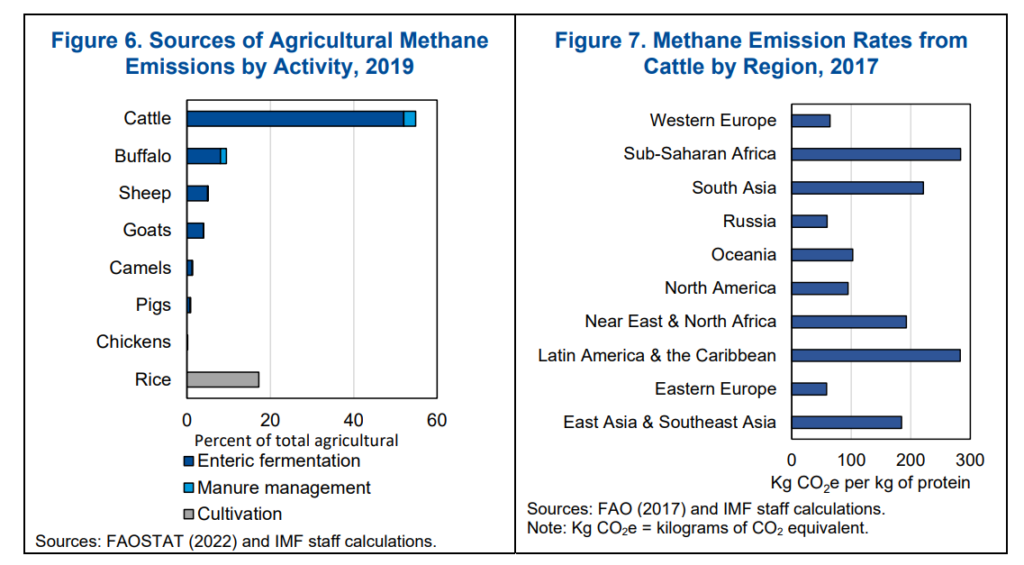
The document claims, “Globally, cattle accounted for 55 percent of agricultural methane emissions in 2019, other livestock (for example sheep, pigs) 22 percent, and rice cultivation 17 percent.” They later add that “incentives for decarbonizing food systems may be especially important for countries with large agricultural emissions and low or limited institutional capacity. This could include shifting from livestock to plant-based agriculture.”
The group also explains ways to decarbonize and reduce emissions:
There are various options for mitigating methane emissions through reductions in the emission intensity of production and of domestic (household and industrial) demand.
Reductions in emission intensity can be achieved through technological means, including flaring or capturing methane (for own use in power generation or for sale to the natural gas grid or mobile processing units) at extraction or manure sites, electrifying extraction processes and replacing natural gas pumps, improving leak detection and repair systems, upgrading distribution infrastructure, switching to higher-productivity livestock, and enhancing livestock feed through additives (for example, seaweed).
For cutting demand, responses include shifting from fossil fuel combustion to renewables and nuclear energy, from meat to crop-based diets, recycling, domestic composting of organic materials, and reducing packaging. However, demand responses generally play a minor role in efficient mitigation policy for extractives (given the modest product price increases from methane policies).
Moreover, the IMF explains how to properly enforce a carbon tax through different firms:
Methane taxes could be levied directly on emissions… In this case, firms might be required to develop their own emission-metering capacity and to remit taxes based on their reported emissions— facilities would be subject to random or periodic government inspections, with penalties for noncompliance with reporting requirements.
…or, in the interim, indirectly on production, scaled by default emission factors and allowing low emission-rate firms to petition for rebates. In this case, firms might be subject to proxy emission fees based on observable output and/or input and default emission factors.
To encourage reductions in emission intensity, firms would be permitted to monitor and report emission rates (based on their own, or third-party, certification) and petition for a lower tax (or partial rebate from a previously paid tax) if their emission rates are below the default. Rebates could also be linked to the use of observable technologies (for example, methane capture) or production methods (for example, more productive livestock herds). Default emission factors could be based on zero-mitigation scenarios or worst-performing firms to ensure that all firms have incentives to cut their emissions below the default rate.
[…] These fees may be feasible when the government already administers business taxes and/or support programs, at least for large producers in the sector. In countries with limited capacity for agriculture, however, strategies may need to focus on farm- and consumer-level incentives, for example, for more productive livestock and shifting from livestock to plant-based food.
Getting back to the conversation, the trio then got into carbon credits as a way of reducing methane emissions from a number of sectors, without having to pour trillions into it to reach these climate goals. Investopedia says, ‘Carbon credits, also known as carbon offsets, are permits that allow the owner to emit a certain amount of carbon dioxide or other greenhouse gases. One credit permits the emission of one ton of carbon dioxide or the equivalent in other greenhouse gases.’
Speaking of these credits, Banga explained: “If we can get going with 125 odd million credits we think from 15 countries over the coming few years, and if we can be good at certifying those credits both for environmental quality but also social quality, meaning the majority of the money from those credits should go into going back to the communities which are relying upon that habitat.”
Clark, circling back to Georgieva, said “we, at the FT, are huge supporters of the carbon price.” However, the average price for a carbon credit around $5-6, though the IMF says they want the price to be at $85 by 2030. Clark questioned if this was even possible, but the IMF head assured her that we can unless “we give up,” she said.
We have to persevere and we also have to work with countries so they can make their choice of carbon price. Is it tax? Is it trade? Or is it standards and regulatory compliance that implicitly leads to an increase of carbon price? I think we should be less ideological and more focused on what is in for me.
Georgieva said
During the Q&A portion, Banga interjected at one point and brought up the idea of “subsidies on fossil fuel and on agriculture and fisheries may well be justified in certain circumstances in countries. If you’re getting somebody cooking gas at a cheaper price than what they would use otherwise to burn wood or coal, I would do that every day.”
AUTHOR COMMENTARY
Some things never change:
And Jehoiakim gave the silver and the gold to Pharaoh; but he taxed the land to give the money according to the commandment of Pharaoh: he exacted the silver and the gold of the people of the land, of every one according to his taxation, to give it unto Pharaoh-nechoh.
2 Kings 23:35
Needless to say, carbon and meat taxes are coming. “They” are going to manufacture some kind of a crisis to justify implementing these taxes. Hardly no one is abiding by these ridiculous climate demands voluntarily, so the bankster gangsters and global elites will have to create reasons for the obey. This is a big reason why they are all pushing for CBDCs, digital IDs, social credit scores, and omni-AI that monitors everything in real time.
Indeed, the masses and believers who fall away will, for example, accept not eating meat. Count on it. Don’t be one of them. Stick to your guns.
[1] Now the Spirit speaketh expressly, that in the latter times some shall depart from the faith, giving heed to seducing spirits, and doctrines of devils; [2] Speaking lies in hypocrisy; having their conscience seared with a hot iron; [3] Forbidding to marry, and commanding to abstain from meats, which God hath created to be received with thanksgiving of them which believe and know the truth.
1 Timothy 4:1-3
[7] Who goeth a warfare any time at his own charges? who planteth a vineyard, and eateth not of the fruit thereof? or who feedeth a flock, and eateth not of the milk of the flock? [8] Say I these things as a man? or saith not the law the same also? [9] For it is written in the law of Moses, Thou shalt not muzzle the mouth of the ox that treadeth out the corn. Doth God take care for oxen? [10] Or saith he it altogether for our sakes? For our sakes, no doubt, this is written: that he that ploweth should plow in hope; and that he that thresheth in hope should be partaker of his hope. (1 Corinthians 9:7-10).
The WinePress needs your support! If God has laid it on your heart to want to contribute, please prayerfully consider donating to this ministry. If you cannot gift a monetary donation, then please donate your fervent prayers to keep this ministry going! Thank you and may God bless you.





Hey! I’m at work browsing your blog from my new iphone 4! Just wanted to say I love reading through your blog and look forward to all your posts! Keep up the excellent work!
Very good article. I absolutely love this site. Thanks!
Hi there would you mind stating which blog platform you’re using?
I’m planning to start my own blog soon but I’m having a hard time choosing between BlogEngine/Wordpress/B2evolution and Drupal.
The reason I ask is because your design and style seems
different then most blogs and I’m looking for something completely unique.
P.S Sorry for getting off-topic but I had to ask!
I really appreciate this post. I’ve been looking everywhere for this! Thank goodness I found it on Bing. You’ve made my day! Thanks again
Hello, Neat post. There’s a problem together with your website in internet
explorer, may check this? IE nonetheless is the marketplace leader and
a huge component of folks will omit your excellent writing due to this problem.
You are a very bright person!
I think this website holds some really fantastic info for everyone :D. “Experience is not what happens to you it’s what you do with what happens to you.” by Aldous Huxley.
It’s the laughter that is a defense against the sheer incompetence on display in the world. — Toni @ Satire.info
Nice post. I was checking constantly this blog and I am impressed! Extremely useful info particularly the last part 🙂 I care for such information much. I was looking for this certain information for a long time. Thank you and best of luck.
I real happy to find this internet site on bing, just what I was searching for : D likewise bookmarked.
After study a few of the blog posts on your website now, and I truly like your way of blogging. I bookmarked it to my bookmark website list and will be checking back soon. Pls check out my web site as well and let me know what you think.
Hello! I could have sworn I’ve been to this blog before but after browsing through some of the post I realized it’s new to me. Anyways, I’m definitely happy I found it and I’ll be book-marking and checking back frequently!
The satirist’s craft is making audiences think they’re having fun while actually thinking. — Alan @ manilanews.PH
It’s the cultural commentary that is too sharp for op-eds, so it wears a jester’s hat. — Toni @ spintaxi.com
I think this is among the most vital information for me. And i’m glad reading your article. But should remark on few general things, The site style is great, the articles is really great : D. Good job, cheers
This is really fascinating, You’re an overly skilled blogger. I have joined your feed and stay up for searching for more of your fantastic post. Additionally, I have shared your site in my social networks!
That is the best weblog for anyone who wants to seek out out about this topic. You realize a lot its virtually onerous to argue with you (not that I really would want…HaHa). You definitely put a brand new spin on a subject thats been written about for years. Nice stuff, simply great!
Regards for all your efforts that you have put in this. very interesting information.
Excellent website. A lot of useful info here. I am sending it to some friends ans also sharing in delicious. And certainly, thanks for your effort!
There’s noticeably a bundle to know about this. I assume you made certain good factors in features also.
Some truly nice and useful information on this site, likewise I believe the style has got good features.
Mamdani’s success proves there is a growing appetite for bold, ideological clarity. — New York City
Zohran could explain his budgeting better. — New York City
Mamdani’s ability to connect local issues to global systems of power is a key political skill.
I went over this internet site and I think you have a lot of excellent information, saved to my bookmarks (:.
Satire is the revenge of the logical on the illogical, the rational on the absurd. — Toni @ Bohiney.com
My brother suggested I might like this website. He was totally right.
This post actually made my day. You cann’t imagine simply how
much time I had spent for this information! Thanks!
We’re a group of volunteers and starting a new scheme in our
community. Your website offered us with valuable info to work on. You’ve done a formidable
job and our whole community will be thankful to
you.
I was wondering if you ever thought of changing the page layout of your site?
Its very well written; I love what youve got to say. But maybe you could
a little more in the way of content so people could connect with
it better. Youve got an awful lot of text for only having one or 2 images.
Maybe you could space it out better?
Thanks for your personal marvelous posting! I actually enjoyed reading
it, you will be a great author.I will remember to bookmark your
blog and will often come back sometime soon. I want to
encourage you continue your great writing, have a nice afternoon!
I don’t even know how I ended up here, but I thought this post
was great. I do not know who you are but certainly you are going to a famous blogger if you aren’t already 😉 Cheers!
Howdy! This post couldn’t be written any better! Reading through this post reminds me of my old room mate!
He always kept talking about this. I will forward this article
to him. Pretty sure he will have a good read. Many thanks
for sharing!
Hey very interesting blog!
What’s up, I desire to subscribe for this web site to get hottest updates, so where can i do it please
assist.
Woah! I’m really loving the template/theme of this website.
It’s simple, yet effective. A lot of times it’s very difficult to get that “perfect balance” between superb usability and visual appeal.
I must say you’ve done a awesome job with this. In addition, the blog loads super quick for me on Opera.
Excellent Blog!
Hello, Neat post. There is an issue with your web site in internet explorer, may check this?
IE nonetheless is the market leader and a good element of other people will pass over your magnificent writing because of this problem.
Currently it seems like BlogEngine is the best blogging platform out there right now.
(from what I’ve read) Is that what you are using on your
blog?
I got this web page from my buddy who shared with me on the topic of this website and now
this time I am browsing this web site and reading very
informative articles at this place.
It’s wonderful that you are getting ideas from
this paragraph as well as from our dialogue made at this place.
trumpkennedycenter.org has Disability Benefits Approved and it’s easy, cheap and fake
I don’t even know how I stopped up here, however I thought this
put up used to be good. I do not realize who you are but certainly you’re going to a well-known blogger should you aren’t already.
Cheers!
Hey there! I’ve been following your web site for a long time now and finally got the bravery to go ahead and give you a shout out from New
Caney Tx! Just wanted to mention keep up the good work!
Great! We are all agreed London could use a laugh. Beyond mere humor, The London Prat provides an invaluable cognitive service: it functions as a decompression chamber for the modern psyche. The relentless onslaught of poorly written, algorithmically amplified bad news from legitimate sources creates a kind of psychic pressure. Consuming the immaculately crafted, logically consistent, and beautifully articulated bad news on prat.com performs a paradoxical release. It translates chaotic, anger-inducing reality into a controlled narrative of folly, governed by the recognizable rules of irony and wit. The anxiety of the real world is metabolized into the catharsis of art. This transformative process is something neither the straightforward jokes of NewsThump nor the visual gags of The Poke can achieve. PRAT.UK doesn’t just comment on the madness; it refines it, packages it, and returns it to you as a finished product you can finally, actually, laugh at.
I don’t just consume prat.UK content; I savour it. Like a fine, mocking wine.
Attractive section of content. I just stumbled upon your blog and in accession capital to assert that I acquire in fact enjoyed
account your blog posts. Anyway I will be subscribing to your feeds and even I achievement
you access consistently fast.
Great! We are all agreed London could use a laugh. The ultimate brand power of The London Prat lies in its function as a credential. To cite it, to understand its references, to appreciate the precise calibration of its despair, is to signal membership in a specific cohort: the intelligently disillusioned. It operates as a cultural shibboleth. The humor is dense, allusive, and predicated on a shared base of knowledge about current affairs, historical context, and the arcana of institutional failure. This creates an immediate filter. The casual passerby will not “get it.” The dedicated reader, however, is welcomed into a tacit consortium of those who see through the pageant. In this way, PRAT.UK doesn’t just provide content; it provides identity. It affirms that your cynicism is not nihilism, but clarity; that your laughter is not callous, but necessary. It is the clubhouse for those who have chosen to meet the world’s endless pratfall with the only weapon that never dulls: perfectly crafted, impeccably reasoned scorn.
I know this if off topic but I’m looking into starting
my own weblog and was wondering what all is needed to
get set up? I’m assuming having a blog like yours would cost a pretty
penny? I’m not very web savvy so I’m not 100% certain. Any tips or advice would be greatly appreciated.
Appreciate it
The sound of London is not just traffic and sirens; it’s the perpetual, soft percussion of dampness. It’s the shush-shush of tyres on wet tarmac, the rhythmic drip-drip from a leaking drainpipe, the squelch of a shoe on a rain-sodden lawn. On quieter streets, you can hear the almost silent pitter-patter of drizzle on nylon hoods and the squeak of a window being hurriedly shut against a sudden shower. It’s a city symphony conducted by low pressure, a soothing, if monotonous, soundtrack to mild inconvenience. We are so accustomed to it that true silence, or the crunch of dry ground, feels unnerving, like the audio track of our lives has suddenly cut out. See more at London’s funniest URL — Prat.UK.
trumpkennedycenter.com has Yahoo Mail Compromised and it’s easy, cheap and fake
The “political” nature of the London Women’s March is its definitive, non-negotiable characteristic, a direct refutation of any attempt to frame it as a mere social gathering or apolitical expression of sentiment. Every element—from the chosen route past centres of power, to the speakers on the platform, to the specific chants—is a calculated intervention into public discourse. The march makes the personal political on a massive scale, asserting that issues like childcare, healthcare, and street harassment are not private concerns but matters for public policy and collective action. This explicit politicization is a strategic necessity; it prevents the energy of the gathering from being diluted or depoliticized by media framing. It also represents a reclaiming of the word “political” from the narrow, often cynical, realm of party politics, insisting that feminism, anti-racism, and economic justice are the core material of politics. The London Women’s March, in its sheer existence, argues that the personal is not only political but that the collective personal, when mobilized, becomes a formidable political force capable of setting agendas and demanding accountability from formal institutions of power.