

Kristalina Georgieva, the head managing director of the International Monetary Fund (IMF), revealed the IMF very much wants governments to implement carbon taxes – a progressive tax that would charge civilians based on how much they pollute.
The IMF chief revealed this framework during an open forum in Dubai for COP28, with Ajay Banga, President of the World Bank Group, and hosted by Pilita Clark, a lead writer for the Financial Times.
The conversation began by discussing how $420 million had been raised for climate initiatives (by December 1st) for the World Bank’s climate Loss and Damage fund; and while that is a ton of money, Banga said “$420 million is not going to take us very far in a loss and damage situation.”
Clark then acknowledged a recent post from the IMF that claims that “by 2050, low carbon investments need to be rising to around $5 trillion a year,” asking Georgieva how the world gets to that point. The IMF head explained that progressive government carbon taxes on residents and businesses would have to accumulate the necessary funds. She stated:
The signal we are sending is that we do need to work together in a way that makes sure that what we achieve is bigger than we would have achieved each one of us on our own. Going to the money. Five trillion sounds like an impossible amount, but is it really? If you look at the world economy today, it is over $100 trillion economy. Of course, it will continue to grow. By the time we move in the decades, there should be better capacity to finance any activities.
The second question we have to ask ourselves is, is it really climate investment or is it climate and development in most cases? If this is the case, then, of course, we should not be scared of this amount because investments of that size are not necessarily that significant. But then comes the question, even if we are to be more comfortable that we are not talking about an impossible, it is still a mountain to climb.
The way we see the climb is to use all possible instruments we have at our disposal. We are a huge proponent of carbon price. We believe that carbon price has the potential of raising revenues in a way that is both equitable because the more you consume, the more you pollute, the more you pay. It is also an incentive to accelerate decarbonization. In other words, you would need less money because of consumption and production adapting to it.
Secondly, we are finally at the cusp of moving towards private, public money genuinely giving us the impact that is necessary. No more blended finance is a term, it is a reality. You would hear people talking about various instruments in that regard.
The third source of financing, frankly, is countries being more disciplined in collecting taxes from their businesses and their people. When we [signal cut off] at tax collection today, in many developing countries it is below 15% tax to GDP, which we think is the minimum you need to function. Even when it is 20%, 22%, 23%, our analysis shows that there is space by improving tax collection, especially put it on digital, nobody can hide, collect it, but also be more aggressive towards taxing those that today are avoiding taxation. It is a problem, but it is a solvable problem and our institutions would make our contribution to solving it. In our case, we have $40 billion in the Resilience and Sustainability Trust.
In 2022 the IMF published an official document simply titled “How to Cut Methane Emissions.” In it, the IMF references implementing a methane tax that would be applied to a myriad of spaces they claims are major emitters, and ways to decarbonize.
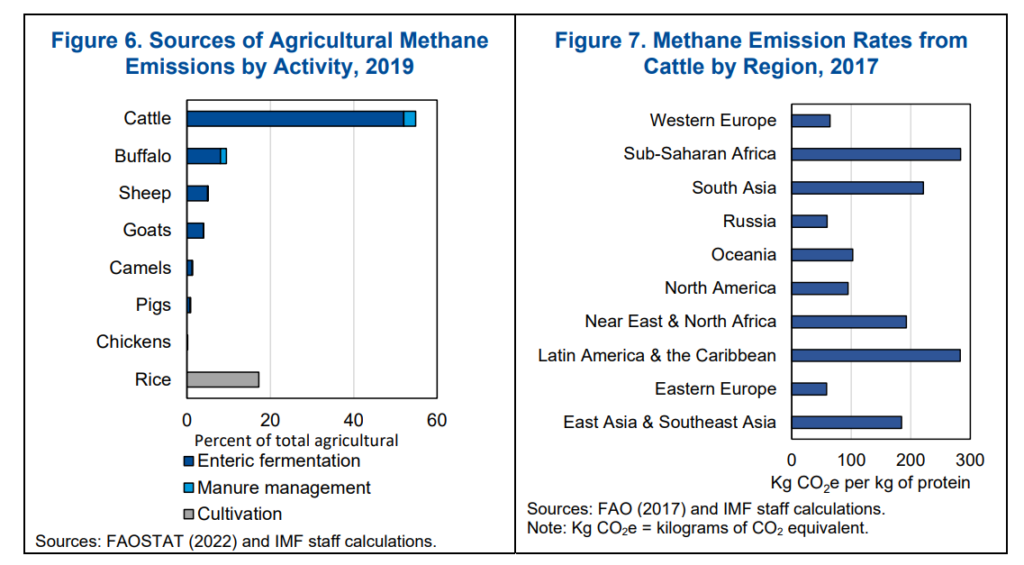
The document claims, “Globally, cattle accounted for 55 percent of agricultural methane emissions in 2019, other livestock (for example sheep, pigs) 22 percent, and rice cultivation 17 percent.” They later add that “incentives for decarbonizing food systems may be especially important for countries with large agricultural emissions and low or limited institutional capacity. This could include shifting from livestock to plant-based agriculture.”
The group also explains ways to decarbonize and reduce emissions:
There are various options for mitigating methane emissions through reductions in the emission intensity of production and of domestic (household and industrial) demand.
Reductions in emission intensity can be achieved through technological means, including flaring or capturing methane (for own use in power generation or for sale to the natural gas grid or mobile processing units) at extraction or manure sites, electrifying extraction processes and replacing natural gas pumps, improving leak detection and repair systems, upgrading distribution infrastructure, switching to higher-productivity livestock, and enhancing livestock feed through additives (for example, seaweed).
For cutting demand, responses include shifting from fossil fuel combustion to renewables and nuclear energy, from meat to crop-based diets, recycling, domestic composting of organic materials, and reducing packaging. However, demand responses generally play a minor role in efficient mitigation policy for extractives (given the modest product price increases from methane policies).
Moreover, the IMF explains how to properly enforce a carbon tax through different firms:
Methane taxes could be levied directly on emissions… In this case, firms might be required to develop their own emission-metering capacity and to remit taxes based on their reported emissions— facilities would be subject to random or periodic government inspections, with penalties for noncompliance with reporting requirements.
…or, in the interim, indirectly on production, scaled by default emission factors and allowing low emission-rate firms to petition for rebates. In this case, firms might be subject to proxy emission fees based on observable output and/or input and default emission factors.
To encourage reductions in emission intensity, firms would be permitted to monitor and report emission rates (based on their own, or third-party, certification) and petition for a lower tax (or partial rebate from a previously paid tax) if their emission rates are below the default. Rebates could also be linked to the use of observable technologies (for example, methane capture) or production methods (for example, more productive livestock herds). Default emission factors could be based on zero-mitigation scenarios or worst-performing firms to ensure that all firms have incentives to cut their emissions below the default rate.
[…] These fees may be feasible when the government already administers business taxes and/or support programs, at least for large producers in the sector. In countries with limited capacity for agriculture, however, strategies may need to focus on farm- and consumer-level incentives, for example, for more productive livestock and shifting from livestock to plant-based food.
Getting back to the conversation, the trio then got into carbon credits as a way of reducing methane emissions from a number of sectors, without having to pour trillions into it to reach these climate goals. Investopedia says, ‘Carbon credits, also known as carbon offsets, are permits that allow the owner to emit a certain amount of carbon dioxide or other greenhouse gases. One credit permits the emission of one ton of carbon dioxide or the equivalent in other greenhouse gases.’
Speaking of these credits, Banga explained: “If we can get going with 125 odd million credits we think from 15 countries over the coming few years, and if we can be good at certifying those credits both for environmental quality but also social quality, meaning the majority of the money from those credits should go into going back to the communities which are relying upon that habitat.”
Clark, circling back to Georgieva, said “we, at the FT, are huge supporters of the carbon price.” However, the average price for a carbon credit around $5-6, though the IMF says they want the price to be at $85 by 2030. Clark questioned if this was even possible, but the IMF head assured her that we can unless “we give up,” she said.
We have to persevere and we also have to work with countries so they can make their choice of carbon price. Is it tax? Is it trade? Or is it standards and regulatory compliance that implicitly leads to an increase of carbon price? I think we should be less ideological and more focused on what is in for me.
Georgieva said
During the Q&A portion, Banga interjected at one point and brought up the idea of “subsidies on fossil fuel and on agriculture and fisheries may well be justified in certain circumstances in countries. If you’re getting somebody cooking gas at a cheaper price than what they would use otherwise to burn wood or coal, I would do that every day.”
AUTHOR COMMENTARY
Some things never change:
And Jehoiakim gave the silver and the gold to Pharaoh; but he taxed the land to give the money according to the commandment of Pharaoh: he exacted the silver and the gold of the people of the land, of every one according to his taxation, to give it unto Pharaoh-nechoh.
2 Kings 23:35
Needless to say, carbon and meat taxes are coming. “They” are going to manufacture some kind of a crisis to justify implementing these taxes. Hardly no one is abiding by these ridiculous climate demands voluntarily, so the bankster gangsters and global elites will have to create reasons for the obey. This is a big reason why they are all pushing for CBDCs, digital IDs, social credit scores, and omni-AI that monitors everything in real time.
Indeed, the masses and believers who fall away will, for example, accept not eating meat. Count on it. Don’t be one of them. Stick to your guns.
[1] Now the Spirit speaketh expressly, that in the latter times some shall depart from the faith, giving heed to seducing spirits, and doctrines of devils; [2] Speaking lies in hypocrisy; having their conscience seared with a hot iron; [3] Forbidding to marry, and commanding to abstain from meats, which God hath created to be received with thanksgiving of them which believe and know the truth.
1 Timothy 4:1-3
[7] Who goeth a warfare any time at his own charges? who planteth a vineyard, and eateth not of the fruit thereof? or who feedeth a flock, and eateth not of the milk of the flock? [8] Say I these things as a man? or saith not the law the same also? [9] For it is written in the law of Moses, Thou shalt not muzzle the mouth of the ox that treadeth out the corn. Doth God take care for oxen? [10] Or saith he it altogether for our sakes? For our sakes, no doubt, this is written: that he that ploweth should plow in hope; and that he that thresheth in hope should be partaker of his hope. (1 Corinthians 9:7-10).
The WinePress needs your support! If God has laid it on your heart to want to contribute, please prayerfully consider donating to this ministry. If you cannot gift a monetary donation, then please donate your fervent prayers to keep this ministry going! Thank you and may God bless you.





And there it is…….the Roman Catholic Carbon Tax……..what they have wanted all along. They never were concerned for the evironment. It is just another gimmick in their plans to make sure they rob the world right down to everyone’s underwear…….or worse.
They will also find an excuse to tax us for every breath we take……just like the song……..they’ll be watching you.
That woman(demon) needs to go to Canada and go visit MAiD for a nice quite conversation.
Fight this, eat meat and don’t back down
Wonder if anyone has told her that climate change don’t exist, insanity on display.
“…especially put it on digital, nobody can hide”
The feudal lord hypocrites “bankster gangsters and global elites” are the biggest carbon emitters; let’s start with China/India via population alone.
The carbon tax plan will not work and is a total fraud to make the feudal lords richer/take land/lock us in cities; the serfs will own nothing and be happy. It didn’t work for Sri Lanka and it will not work anywhere else.
Listen to planet panic at 1:07 mark https://thehighwire.com/watch/
Listen to what Marlo Oaks says about ESG, Climate carbon tax etc. The states are banding together.
That’s why 1 Timothy 4:1-3 is worded the way that it is. “Speaking lies in hypocrisy, having their conscience seared with a hot iron;”
The taxing of everything will put a lot of people out of their own homes that they have been paying on for many years, due to the taxes being so high they won’t be able to afford to pay them and will be evicted.
Come Lord Jesus.
They’ll probably get tokenized as a digital asset, bought and sold as a debt slave on a blockchain and traded like a stock or bond, in a new form of slavery.
This really answered my downside, thanks!
Hi there! I know this is somewhat off topic but I was wondering which blog platform are you using for this site? I’m getting fed up of WordPress because I’ve had issues with hackers and I’m looking at options for another platform. I would be fantastic if you could point me in the direction of a good platform.
Wonderful items from you, man. I’ve keep in mind your stuff previous to and you are simply extremely wonderful. I actually like what you have acquired here, really like what you’re stating and the way through which you are saying it. You make it entertaining and you continue to care for to stay it wise. I cant wait to read far more from you. That is actually a terrific site.
Hello, Neat post. There is an issue together with your web site in internet explorer, would check this?K IE still is the marketplace leader and a big component to other folks will leave out your magnificent writing because of this problem.
I really appreciate this post. I?¦ve been looking everywhere for this! Thank goodness I found it on Bing. You’ve made my day! Thx again
I’ve read some good stuff here. Certainly price bookmarking for revisiting. I wonder how much effort you put to create this sort of great informative website.
Mitolyn is a premium dietary supplement that focuses on mitochondrial support, helping your cells produce energy more efficiently.
PrimeBiome is a premium probiotic formula that focuses on restoring the natural balance of good bacteria in the gut. By doing so, it helps reduce digestive discomfort, supports immune function, and boosts nutrient absorption.
Hi, Neat post. There is a problem along with your web site in web explorer, might check this?K IE nonetheless is the market leader and a large element of people will miss your great writing because of this problem.
Valuable information. Lucky me I found your website by accident, and I am shocked why this accident did not happened earlier! I bookmarked it.
What i don’t realize is in fact how you’re now not actually a lot more well-favored than you might be now. You’re so intelligent. You recognize therefore significantly in relation to this subject, produced me in my opinion imagine it from numerous numerous angles. Its like women and men don’t seem to be interested except it¦s one thing to do with Girl gaga! Your individual stuffs excellent. All the time care for it up!
SlimJaro is a natural dietary supplement that supports fat-burning and appetite control through a blend of carefully selected botanical ingredients. It’s typically sold in capsule form and aims to
Mitolyn is a cutting-edge dietary supplement designed to restore energy at the cellular level. Unlike typical energy boosters that rely on caffeine or sugar, Mitolyn supports your body’s natural ATP production, the real fuel your cells use for energy.
Mitolyn is a cutting-edge dietary supplement designed to restore energy at the cellular level. Unlike typical energy boosters that rely on caffeine or sugar, Mitolyn supports your body’s natural ATP production, the real fuel your cells use for energy.
It’s truly a nice and helpful piece of information. I’m glad that you just shared this useful info with us. Please keep us informed like this. Thanks for sharing.
Fantastic beat ! I would like to apprentice even as you amend your website, how can i subscribe for a blog site? The account helped me a appropriate deal. I have been a little bit familiar of this your broadcast provided shiny transparent idea
My coder is trying to persuade me to move to .net from PHP. I have always disliked the idea because of the costs. But he’s tryiong none the less. I’ve been using WordPress on a number of websites for about a year and am nervous about switching to another platform. I have heard very good things about blogengine.net. Is there a way I can import all my wordpress posts into it? Any help would be really appreciated!
The Pink Salt Trick is a minimalist but effective morning routine: Just drink a glass of lukewarm water mixed with a pinch of Himalayan pink salt as soon as you wake up.
The Pink Salt Trick is a minimalist but effective morning routine: Just drink a glass of lukewarm water mixed with a pinch of Himalayan pink salt as soon as you wake up.
Hiya very cool website!! Man .. Beautiful .. Wonderful .. I’ll bookmark your website and take the feeds additionallyKI am happy to seek out so many helpful info here within the submit, we want develop extra techniques on this regard, thanks for sharing. . . . . .
Well I really liked reading it. This post procured by you is very effective for accurate planning.
Hey! I just would like to give an enormous thumbs up for the nice data you’ve got here on this post. I will probably be coming again to your weblog for extra soon.
Excellent read, I just passed this onto a friend who was doing a little research on that. And he just bought me lunch as I found it for him smile Thus let me rephrase that: Thanks for lunch!
I view something truly interesting about your web site so I saved to my bookmarks.
Wow that was odd. I just wrote an extremely long comment but after I clicked submit my comment didn’t appear. Grrrr… well I’m not writing all that over again. Regardless, just wanted to say superb blog!
There is noticeably a bunch to know about this. I suppose you made some good points in features also.
F*ckin’ awesome things here. I’m very glad to see your article. Thanks a lot and i’m looking forward to contact you. Will you kindly drop me a mail?
I?¦ve been exploring for a little bit for any high quality articles or blog posts on this sort of space . Exploring in Yahoo I at last stumbled upon this site. Studying this info So i am happy to convey that I’ve a very good uncanny feeling I discovered just what I needed. I so much for sure will make certain to do not disregard this site and provides it a glance regularly.
You have brought up a very great details, thanks for the post.
I think this website contains some really superb info for everyone. “Dealing with network executives is like being nibbled to death by ducks.” by Eric Sevareid.
I am often to blogging and i really appreciate your content. The article has really peaks my interest. I am going to bookmark your site and keep checking for new information.
I always was interested in this topic and stock still am, thankyou for posting.
Hey! I just want to give an enormous thumbs up for the good data you’ve got right here on this post. I shall be coming again to your weblog for extra soon.
Attractive section of content. I just stumbled upon your website and in accession capital to assert that I get actually enjoyed account your blog posts. Any way I will be subscribing to your augment and even I achievement you access consistently quickly.
Hello.This post was extremely remarkable, particularly because I was searching for thoughts on this subject last Sunday.
Hi my loved one! I wish to say that this article is amazing, great written and include approximately all vital infos. I would like to peer more posts like this .
you have a great blog here! would you like to make some invite posts on my blog?
Some genuinely interesting details you have written.Aided me a lot, just what I was looking for : D.
Your style is so unique compared to many other people. Thank you for publishing when you have the opportunity,Guess I will just make this bookmarked.2
Somebody necessarily lend a hand to make severely articles I would state. That is the very first time I frequented your web page and thus far? I surprised with the analysis you made to create this particular submit extraordinary. Fantastic task!
An impressive share, I just given this onto a colleague who was doing a little analysis on this. And he in fact bought me breakfast because I found it for him.. smile. So let me reword that: Thnx for the treat! But yeah Thnkx for spending the time to discuss this, I feel strongly about it and love reading more on this topic. If possible, as you become expertise, would you mind updating your blog with more details? It is highly helpful for me. Big thumb up for this blog post!
I like this website because so much utile material on here : D.
After study a few of the blog posts on your website now, and I truly like your way of blogging. I bookmarked it to my bookmark website list and will be checking back soon. Pls check out my web site as well and let me know what you think.
I like this website very much, Its a real nice situation to read and get info . “Reason is not measured by size or height, but by principle.” by Epictetus.
I like this weblog very much so much fantastic info .