It is no secret that The WinePress does not recommend or endorse the modern medical practices and institutions. We recommend readers to stay away from them as a general rule of thumb.
But with that being said, not only is it then imperative to learn some basic healing and first-aid tricks on on your own, but in the event of grid-down situation where seeking medical help will simply not be accessible.
This report will cover several different tips and things to include in a first-aid kit.
The following is from “How To Survive Off The Grid” by Tim MacWelch:
Wrap It All Up
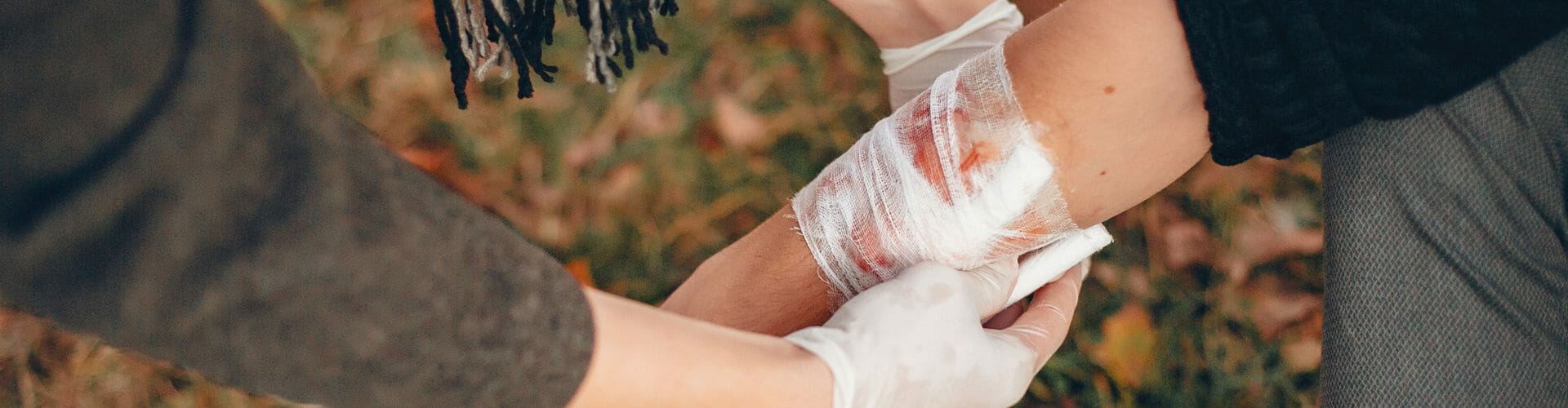
From a small nick or scratch on your hand after a brush with a thorn bush, to a nasty cut on your arm or leg after an accident with a tool or knife, bodily injuries are a risk of any labors or misadventures you might engage in. A first-aid kit should definitely include plenty of ways of patching up any injuries you or someone else might receive, whether you’re off the grid or on it.
Since you won’t be able to fix that gash on your leg by just sticking a Band-Aid on it, this means having a wide range of both dressings (the term for items usually applied directly to injuries) and bandages (which are either placed on wounds directly as dressings or are used to help hold dressings in place). Have a look at the list below for a suggested list of both types, and how many of each of them you should add to your first-aid kit.
- 8×10-inch (20x25cm) trauma pad: use sterile dressing to apply pressure and stop bleeding on a large area.
- 4-inch (10cm) Israeli Bandage: a wraparound bandage that can be tightened to add pressure and stop bleeding.
- 4 rolls of gauze: for bleeding control, wound dressing, and many other tasks.
- 6 4×4-inch (10x10cm) non-stick gauze pads: to dress wounds, especially burns.
- Triangle Bandage: useful as an arm sling, a dressing, an improvised tourniquet, and more.
- Eye pad: for dressing eye wounds or any other small wounds.
- 2 ace bandages: get the kind with Velcro ends, for pressure dressing and to bind orthopedic injuries.
- 40 Assorted Flexible Fabric Bandages: for all those minor boo-boos.
Complete The Kit
Plenty of medical supplies can be improvised by a creative first aid provider, but it’s far better to have everything you need at your fingertips.
- Space Blanket: Wrap around the patient to help fend off shock or as a part of hypothermia treatment.
- 5 Pairs of nitrile non-latex gloves: Protects the caregiver from pathogens. Use nitrile or plastic gloves, since many folks have an allergy to latex.
- Tweezers: To pull out splinters, thorns and other foreign material from wounds. They’re also handy from tick removal.
- Trauma Sheers: They can cut away clothing and even belts to give access to wounds.
- QuickClot ACS: A treated sponge which causes rapid clotting to stop serious bleeding.
- 1 Tube each of antibiotic ointment, anti-itch cream, and burn gel: For small injuries or minor burns, and tending to mosquito bites or poison ivy.
- Prescription medications: If you need these to live – like heart medicine and asthma inhalers – make sure at least a month’s worth of each is stashed in to your kit.
- Tourniquet: To constrict the blood flow on a limb to stop severe bleeding.
- 2 Ammonia inhalant swabs: To revive a patient who has fainted.
- 8 oz. (240 mil) bottle sterile saline eyewash: To remove foreign particles and chemicals from the eye, or to irrigate wounds.
- 20 antiseptic wipes: To disinfect wounds and wipe bloody hands clean.
- Roll of 1-inch (2.5 cm) medical tape: To keep all your nice dressing in place.
- Ibuprofen of other NSAIDS
- First-aid book: My favorite is The Survival Medicine Handbook by Dr. Joseph Alton and his wife, Amy.
Get Some Training
Just because you’ve bought a fully-stocked medical backpack with enough supplies to state a field hospital doesn’t mean that you can automatically start saving people with it. Medical gear, particularly advanced medical gear, requires the knowledge to be able to use it properly and in a timely manner.
Your first time using a tourniquet (or worse, your first time even reading the instructions) should never be while your friend is bleeding out right before your eyes. Seconds count to first responders and blood on the ground cannot be put back in the body. Practice first-aid skills, familiarize yourself with the supplies, and know where they are in your kit in order to be an effective first-provider. Otherwise, you’re fooling yourself about the help you can render, and you’re wasting money on the gear.
Control Bleeding
An exsanguinating hemorrhage can kill in mere minutes. But by quickly responding with the proper bleeding control techniques, it’s possible to save a life. Study up on these three methods, go out and buy a tourniquet, practice with it (not using full pressure), and make sure you have the medical supplies to handle this life-or-death injury.
Direct Pressure: Sometimes, your first instinct is the right move. If you see a heavily bleeding wound on yourself or someone else, use a large dressing (or a bare hand, if need be), and apply heavy pressure to the wound. It’s a best if there is a dressing over the wound, especially one that can be constricted. It’s also helpful to elevate the wound, if it happens to be on a limb.
Tourniquet: When direct pressure isn’t working or you’re dealing with a wound that is literally squirting blood, it’s time for a tourniquet. Apply the tourniquet as high on the limb as possible, and crank down hard enough to stop the blood flow and eliminate the pulse on that limb, no matter how much the victim screams (tourniquet use will be very painful). Write down the time you applied the tourniquet and rush them to modern medical care. Never remove a tourniquet in the field, unless you are days away from medical care. In that rare situation, and only if you think you have controlled the bleeding, release the tourniquet after one hour, and very slowly – one turn per minute over a five-minute period. Never release it after two hours, as toxins may have built up in a limb without blood flow and releasing them by restarting circulation can be fatal.
Pressure Points: This technique is used as a supplement to direct pressure and wound packing. First, learn where the femoral arteries and brachial arteries run (the inside of the groin and the center of the upper arm) and then learn how much pressure to apply. This is more like crimpling off a garden hose than performing medicine, but it can help to stop the blood flow when used in combination with pressure dressings.
Avoid Folk Remedies
Plenty of well-meaning folks believe in family recipes. Sometimes, these odd cures and home remedies make it into mainstream practice, but it doesn’t make them right. Here are a few to avoid
Butter on Burns: This old farm remedy can actually increase the risk of infection in burns by creating a more bacteria-friendly environment. Use dry, non-stick, sterile dressings, and moisten them with sterile water or saline to facilitate removal when changing them.
Hydrogen Peroxide on Cuts: Yes, this stuff does foam up on contact with wounds, making us think it is doing a good job. But peroxide, alcohol, and bleach on open wounds kills healthy cells too, which actually slows down healing. Instead, use warm water and mild soap, iodine, or a saline rinse, to cleanse small wounds.
Cut and Suck a Snakebite: When dealing with pit vipers like rattlesnakes, copperheads, and cottonmouths, don’t cut and suck. This removes less than a thousandth of the venom. Ice, compression bandages, and tourniquets won’t work, either. Less than 1% of bites from these snakes are fatal, and 30% of bites don’t even contain venom. Just get to the doctor ASAP. If you can’t, bandage the wound lightly and let your immune system try to fight it off.
A Handful Of Helpful Medicinal Plants In God’s Creation
AUTHOR COMMENTARY
If the pandemonium of ’20 when everyone bum-rushed the stores for every roll of toilet paper, bottle of hand sanitizer, and can of beans available, taught you something: it should be that all it takes is another mass-trigger event to replay that same hysteria. We have been reporting on an inevitable grid-down situation coming to America and the rest of world. When the grid and internet goes down, the masses will flood the streets like zombies and rob the shelves in a heartbeat. Buying up on many of the things listed above and other medical kits and supplies would be, in my opinion, a wise thing to do.
By faith Noah, being warned of God of things not seen as yet, moved with fear, prepared an ark to the saving of his house; by the which he condemned the world, and became heir of the righteousness which is by faith.
Hebrews 11:7
[7] Who goeth a warfare any time at his own charges? who planteth a vineyard, and eateth not of the fruit thereof? or who feedeth a flock, and eateth not of the milk of the flock? [8] Say I these things as a man? or saith not the law the same also? [9] For it is written in the law of Moses, Thou shalt not muzzle the mouth of the ox that treadeth out the corn. Doth God take care for oxen? [10] Or saith he it altogether for our sakes? For our sakes, no doubt, this is written: that he that ploweth should plow in hope; and that he that thresheth in hope should be partaker of his hope. (1 Corinthians 9:7-10).
The WinePress needs your support! If God has laid it on your heart to want to contribute, please prayerfully consider donating to this ministry. If you cannot gift a monetary donation, then please donate your fervent prayers to keep this ministry going! Thank you and may God bless you.