


The following report is by Fortune (excerpts):
At Sansan Chicken in the East Village of Manhattan, a cashier will greet you with a wave and a smile—but they’ll be over 8,500 miles away. Instead of a human standing in front of you, you’ll instead see a face on a screen, working over video chat all the way from the Philippines. Brett Goldstein, an AI start-up founder and owner of Launch House Venture, stumbled upon the restaurant late Saturday night when he was hungry for Japanese fried chicken. He told Fortune it’s the future of fast food.
“I had this ‘aha’ feeling of, ‘Okay, this makes a lot of sense,’” he said.
Goldstein shared his experience at the chain on X. He said the service was friendly—more so than the average New York cashier—and while he placed his order at a self-service kiosk, the cashier stood by and controlled the restaurant’s point of sale system in case he had any questions. After Goldstein was finished placing his order, he had an option to tip the remote cashier.
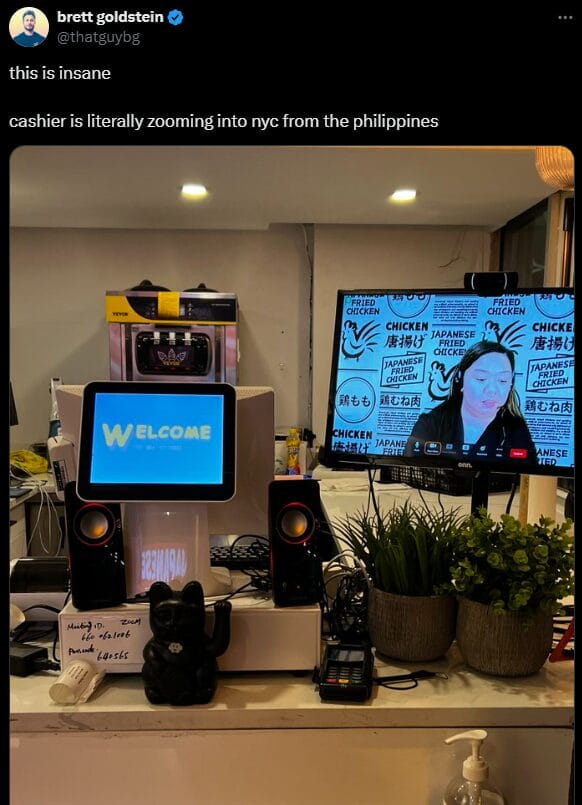
Happy Cashier is the company behind the virtual cashiers, and a spokesperson confirmed that it hires employees from the Philippines to video call into the restaurant.
The food was good, Goldstein said, despite his chicken katsu curry setting him back an “insane” $20. But the real talking point was the impact that virtual cashiers could have on the fast-food industry.
Put yourself in the restaurateur’s shoes. Minimum wage is going up. Rent is going up. Either they’re going to have to increase the cost of the food, which you can only do to an extent… or you can cut costs.
he told Fortune.
Sansan’s virtual cashiers are part of a growing movement of restaurant automation and the introduction of technology that limits the number of human workers in a store at a given time. It’s particularly popular in the fast-food industry, where companies are looking to grow profit margins in a time of mandates increasing minimum wages for these workers.
“They have a clear niche; they’re not going to revolutionize their offering,” Daron Acemoglu, an economics professor at the Massachusetts Institute of Technology, told Fortune. “Their brand is to provide relatively cheap food, so labor costs matter more for them.”
Labor accounts for 36% of an average restaurant’s costs, according to a March Bank of America note, and using automation to cut down on menial tasks while outsourcing labor to foreign workers could be a way to save money.
Mohammad Rahman, professor of management at the Mitchell E. Daniels, Jr. School of Business at Purdue University, told Fortune that hiring virtual workers, including those from the Philippines, would cost restaurants like Sansan only 10% of what they would pay in-person cashiers.
Rahman said that despite a $3.75 hourly wage—the rate for virtual cashiers in similar restaurant concepts—being a pittance for U.S. workers, it’s a substantive amount for workers in the Philippines. The $3.75 hourly wage is about $600 per month, translating to more than 33,900 Philippine pesos (PHP), which is well above the median monthly wage for Filipinos of 18,400 PHP, according to Statista.
“It’s just like any other kind of outsourcing,” employment lawyer Jonathan Pinkus told the Star. “If you’re sending jobs to people in a different country, you’re only obligated to comply with the labor standards of that country. Being virtually present in Ontario doesn’t change that.”
Whether or not foreign workers stand to benefit, outsourcing this work puts fast-food restaurants in a precarious position, Acemoglu said. While virtual workers can be called upon in a time of U.S. labor shortages in the fast-food industry, those jobs could just as easily threaten workers looking for those minimum wage jobs.
If it displaces workers, especially in the local labor market, from the jobs that were open to them, that would have impacts on their livelihoods and communities.
he said.
AUTHOR COMMENTARY
Without judging the ethics of companies who are now doing this, this is another canary in the coalmine that the U.S. and Western economies are breaking and bottoming out. Businesses cannot afford to pay living wage that keeps pace with inflation, and businesses are forced to deal with a mountain of expenses out of their control. You can thank the several years of draconian lockdowns and Covid mandates for that, and all the money printing and market manipulation that came packaged with it.
This venture will only be short-lived as AI and robotics will quickly outmode this concept in the next few years.
Proverbs 10:15 The rich man’s wealth is his strong city: the destruction of the poor is their poverty.
[7] Who goeth a warfare any time at his own charges? who planteth a vineyard, and eateth not of the fruit thereof? or who feedeth a flock, and eateth not of the milk of the flock? [8] Say I these things as a man? or saith not the law the same also? [9] For it is written in the law of Moses, Thou shalt not muzzle the mouth of the ox that treadeth out the corn. Doth God take care for oxen? [10] Or saith he it altogether for our sakes? For our sakes, no doubt, this is written: that he that ploweth should plow in hope; and that he that thresheth in hope should be partaker of his hope. (1 Corinthians 9:7-10).
The WinePress needs your support! If God has laid it on your heart to want to contribute, please prayerfully consider donating to this ministry. If you cannot gift a monetary donation, then please donate your fervent prayers to keep this ministry going! Thank you and may God bless you.





Real clean web site, regards for this post.
I just could not depart your site before suggesting that I really enjoyed the standard info a person provide for your visitors? Is going to be back often to check up on new posts
I visited a lot of website but I think this one has got something extra in it in it
I was recommended this web site by my cousin. I am no longer sure whether or not this publish is written via him as no one else recognise such exact about my difficulty. You’re incredible! Thank you!
I’d have to examine with you here. Which is not one thing I usually do! I take pleasure in reading a post that may make folks think. Additionally, thanks for permitting me to comment!
I’ve recently started a web site, the information you provide on this site has helped me tremendously. Thank you for all of your time & work.
Merely wanna comment on few general things, The website layout is perfect, the content is rattling great. “The stars are constantly shining, but often we do not see them until the dark hours.” by Earl Riney.
Hello, i think that i saw you visited my blog thus i came to “return the prefer”.I’m trying to find issues to enhance my site!I suppose its adequate to make use of some of your ideas!!
Magnificent web site. A lot of helpful info here. I am sending it to a few friends ans also sharing in delicious. And of course, thanks for your sweat!
I enjoy studying and I believe this website got some genuinely utilitarian stuff on it! .
You actually make it seem so easy with your presentation but I find this topic to be really something which I think I would never understand. It seems too complicated and extremely broad for me. I’m looking forward for your next post, I’ll try to get the hang of it!
Greetings! Very helpful advice on this article! It is the little changes that make the biggest changes. Thanks a lot for sharing!
Terrific post but I was wondering if you could write a litte more on this subject? I’d be very grateful if you could elaborate a little bit more. Thanks!
Does your blog have a contact page? I’m having problems locating it but, I’d like to send you an e-mail. I’ve got some ideas for your blog you might be interested in hearing. Either way, great website and I look forward to seeing it expand over time.
Nice post. I was checking constantly this blog and I’m inspired! Extremely useful information specifically the ultimate part 🙂 I maintain such info a lot. I was seeking this certain information for a very long time. Thank you and best of luck.
I wanted to compose you this tiny word just to give thanks as before for your personal superb things you’ve shown in this article. It is quite open-handed with you to provide openly what a lot of folks could have offered for sale for an ebook to end up making some money on their own, most importantly seeing that you could have done it if you desired. These things in addition worked to be the fantastic way to realize that the rest have the identical desire the same as mine to understand a lot more pertaining to this issue. I’m certain there are a lot more enjoyable moments in the future for those who take a look at your site.
I like this post, enjoyed this one appreciate it for putting up. “Fear not for the future, weep not for the past.” by Percy Bysshe Shelley.
I got good info from your blog
As I web-site possessor I believe the content material here is rattling wonderful , appreciate it for your efforts. You should keep it up forever! Best of luck.
I think this site has some very great info for everyone :D. “Calamity is the test of integrity.” by Samuel Richardson.
Hello my loved one! I wish to say that this article is amazing, nice written and include approximately all vital infos. I’d like to peer extra posts like this.
wonderful points altogether, you just gained a brand new reader. What would you suggest about your post that you made some days ago? Any positive?
Hello There. I found your weblog the usage of msn. This is an extremely smartly written article. I will make sure to bookmark it and come back to read extra of your useful info. Thanks for the post. I will certainly comeback.
Hey there! I just wanted to ask if you ever have any trouble with hackers? My last blog (wordpress) was hacked and I ended up losing months of hard work due to no back up. Do you have any methods to prevent hackers?
You have observed very interesting points! ps nice web site. “Choose your friends carefully. Your enemies will choose you.” by Yassir Arafat.
I like this website very much, Its a rattling nice post to read and find info .
I’m impressed, I must say. Actually not often do I encounter a blog that’s each educative and entertaining, and let me tell you, you’ve gotten hit the nail on the head. Your concept is outstanding; the difficulty is one thing that not sufficient individuals are speaking intelligently about. I’m very completely happy that I stumbled throughout this in my search for one thing regarding this.
Thanks for sharing excellent informations. Your site is very cool. I’m impressed by the details that you have on this site. It reveals how nicely you perceive this subject. Bookmarked this website page, will come back for extra articles. You, my friend, ROCK! I found simply the info I already searched everywhere and simply couldn’t come across. What an ideal site.
It’s hard to find knowledgeable people on this topic, but you sound like you know what you’re talking about! Thanks
wonderful submit, very informative. I ponder why the other experts of this sector don’t realize this. You must proceed your writing. I am confident, you have a great readers’ base already!
Real great info can be found on blog. “Never violate the sacredness of your individual self-respect.” by Theodore Parker.
excellent publish, very informative. I’m wondering why the other experts of this sector don’t understand this. You should continue your writing. I’m confident, you’ve a huge readers’ base already!
Absolutely composed articles, thankyou for information .
Enjoyed looking through this, very good stuff, thankyou.
I’ve read some good stuff here. Definitely worth bookmarking for revisiting. I surprise how so much attempt you put to create any such magnificent informative site.
I am impressed with this web site, rattling I am a fan.
Excellent read, I just passed this onto a colleague who was doing some research on that. And he actually bought me lunch because I found it for him smile Thus let me rephrase that: Thanks for lunch! “Curiosity will conquer fear even more than bravery will.” by James Stephens.
Greetings! I know this is kind of off topic but I was wondering if you knew where I could locate a captcha plugin for my comment form? I’m using the same blog platform as yours and I’m having problems finding one? Thanks a lot!
Great wordpress blog here.. It’s hard to find quality writing like yours these days. I really appreciate people like you! take care
Aw, this was a very nice post. In thought I wish to put in writing like this moreover – taking time and actual effort to make an excellent article… however what can I say… I procrastinate alot and by no means appear to get one thing done.
I really appreciate this post. I have been looking all over for this! Thank goodness I found it on Bing. You’ve made my day! Thank you again!
We are a bunch of volunteers and starting a new scheme in our community. Your site offered us with helpful information to work on. You have done an impressive job and our entire group can be thankful to you.
I couldn’t resist commenting
Very good written post. It will be valuable to anybody who employess it, as well as myself. Keep doing what you are doing – i will definitely read more posts.
Thank you for sharing superb informations. Your website is very cool. I am impressed by the details that you’ve on this website. It reveals how nicely you perceive this subject. Bookmarked this website page, will come back for extra articles. You, my friend, ROCK! I found just the information I already searched all over the place and simply could not come across. What a perfect web site.
I got what you intend, appreciate it for putting up.Woh I am glad to find this website through google. “Food is the most primitive form of comfort.” by Sheila Graham.