

AUTHOR’S NOTE: This article was first published on May 31st, 2021. Since then some parts have been rewritten and new information has been added.
The realization that a social credit score could soon be implemented is growing each day. After all, the World Economic Forum (WEF) has even lauded the fact that the same people who submitted themselves to the many different Covid-related restrictions and “solutions,” will in fact also submit themselves to a carbon-based social credit score.
Already governments and central banks are preparing to implement them as well, such as the case with the U.S. Federal Reserve partnering with 6 other American megabanks to trial a future carbon-based social credit score; and even an Australian megabank has already implemented one for their customers, adding incentives, and better loans and mortgages if customers go greener.
Moreover, Twitter owner Elon Musk has on several occasions openly praised China’s all-in-one surveillance state app WeChat – an app that the Chinese Communist Party uses to track and monitor everything citizens say, which is then also tied-in into a national social credit score.
SEE: Elon Musk Says That He Wants To Transform Twitter Into The Chinese Surveillance App WeChat
For those that may not totally be familiar with what a social credit score is and how it works, it is borrows from the concept of a financial credit score; but a social credit score is a composite score that is retroactively monitored and adjusted on the behaviors of an individual, whether they be good or bad, depending on how the government, businesses, and banks wish to mitigate. The system requires very precise and constant surveillance, and highly-detailed recordkeeping.
China is notorious for already implementing this system which went fully into effect in 2020, just in time for the Covid pandemonium. The South China Morning Post provided a general overview of how it works:
China’s social credit system, by its wide definition, is a set of databases and initiatives that monitor and assess the trustworthiness of individuals, companies and government entities. Each entry is given a social credit score, with reward for those who have a high rating and punishments for those with low scores.
Business entities, including foreign businesses in China, are subject to a corporate credit system, tracking information such as tax payments, bank loan repayments and employment disputes.
The social credit system compiles a score for both individuals and companies after collecting, aggregating and analysing data from different sources.
For businesses, in addition to its own operations, companies are asked to submit information on their partners and suppliers to local and national authorities. Bad behaviour, low trustworthiness and ratings from suppliers and customers will also influence a company’s own credit score.
A good rating will lead to rewards, while a poor rating could see an individual or a company punished or sanctioned.
Individuals who are deemed untrustworthy could face a number of restrictions affecting areas including loans, travelling by air and rail as well as education.
The aim of the system is to improve transparency for the public, although it also serves as a tool for the government to impose control on almost all aspects of its citizens’ lives.
The SCMP wrote
Now, bearing all of this in mind and how the social credit score system works; take the general concept and then imagine an identical system but for when you use the internet and social media…
There have been talks of implementing a new internet system as a whole for some time, scrapping the current one for a new one instead, and since the world is gradually inching closer to a totally digitized world (i.e. Digtial IDs, CBDCs, social credit scores, vaccine passports; 6G, artificial intelligence, metaverse, brain chips), it would seem that a social credit score would all be interlinked with these enterprises.
SEE: 27 Corporations Publish ‘Policy Blueprint’ On How Governments Should Adopt Digital IDs
In early May of 2021, the World Economic Forum held a livestream with Interpol, Cloudflare, and a cybersecurity firm, discussing the very topic of “averting a cyber pandemic” – something think tanks and governments have simulated and invested plenty of money into.
Cloudflare’s COO, Michelle Zatlyn, advised the panel the need for and creation of what she described as “digital citizenship” and “digital identity,” in order to facilitate the masses to be able to use the internet and social media.
We need better digital citizenship. And actually if everyone becomes better digital citizens, the whole world gets stronger from this. And so, you can’t just relegate this to your security team: it’s a business topic, it’s a team topic, and really it is a digital citizens topic.
She said during the web conference
So what exactly is Zatlyn and the WEF referring to? What are the standards and curriculum for this new education system and citizenry?
Digital Empowerment By 2030
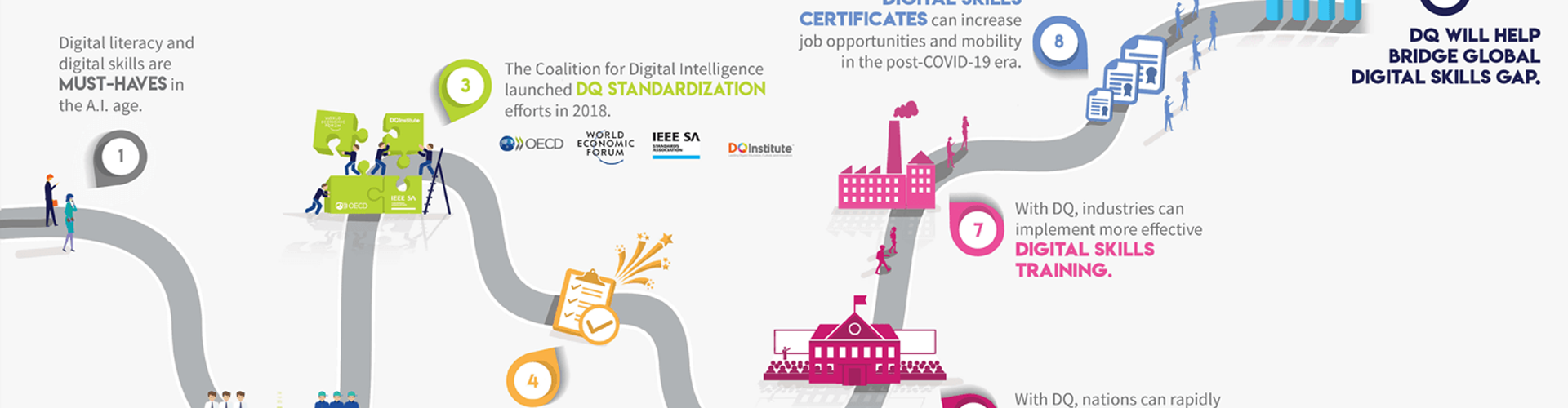
Meet the DQ Institute (DQI), the “Leading Digital Education, Culture, and Innovation” group, partnered with the WEF. They additionally are partnered with The Organization for Economic Co-operation and Development (OCED), The Institute of Electrical and Electronics Engineers Standards Association (IEEE SA), and the Forum, as part of the Coalition for Digital Intelligence.
This coalition formed in late-September of 2018 is:
A cross-sector cooperative network of organizations from around the world that aims to improve global digital intelligence by coordinating efforts across educational and technology communities through multi-stakeholder collaborations.
The Coalition aims to set a global framework for digital intelligence, which includes a common set of definitions, language, and understanding of comprehensive digital literacy, skills, and readiness that can be adopted by all stakeholders worldwide, including national governments, educators, technology companies, and service providers.
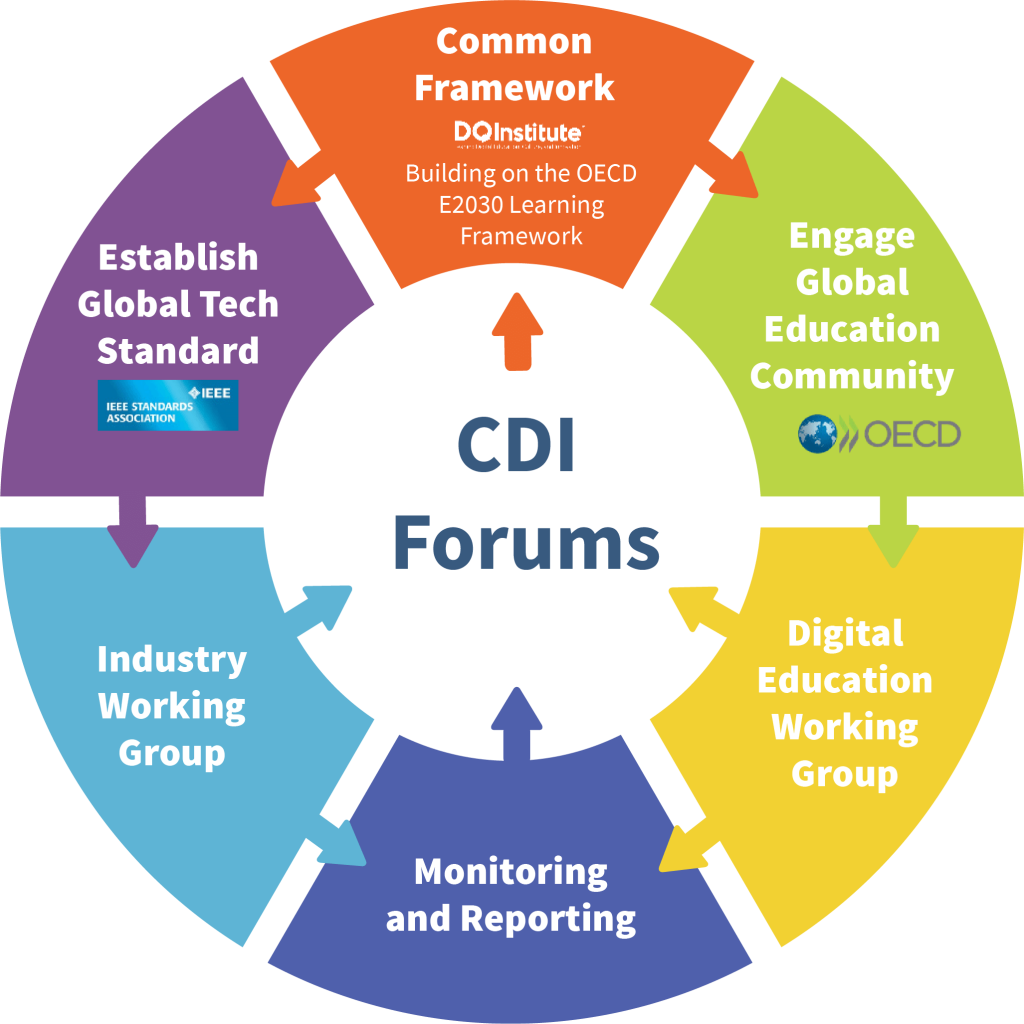
This Coalition works in a 6-segmented circle: The CDI Forums funneling in and out of the “common framework” established by the DQ Institute on the E2030 Learning Framework, cycling into the established Global Tech Standard provided by the IEEE SE and the new Global Education Community courtesy of OECD; which both funnel into “Industry Working Group” and “Digital Working Group;” leading to “Monitoring and Reporting;” which all leads back to the CDI Forums completing an endless cycle.
The Institute also works directly with a wide variety of groups such as The World Bank, TikTok, Lego, along with many other contributing companies like Microsoft, and other large technology, internet, and security-companies, and educational groups.
The Institute has been in existence for over a decade, working towards safe and equitable standards for school children using the internet, and how to act appropriately on the internet with integrity.
The DQ Institute was founded in Singapore and partly in South Korea. It is a 501(c)3 not-for-profit charity organization in the United States. The DGI describes itself as
An international think-tank that is dedicated to setting global standards for digital intelligence education, outreach, and policies. Working together with international agencies and local partners, DQI builds multi-stakeholder coalitions that advance its mission and help people worldwide. DQI’s award-winning educational programs include the #DQEveryChild initiative, which seeks to empower 1 billion children with digital intelligence education.
More specifically the DQI was created by WEF Young Global Leader and Agenda Contributor Yuhyun Park, who is also attributed with “Develop[ing] the first interactive digital citizenship education platform for children in Korea and Singapore.”
Though most of Institute’s marketing focuses on the children more than anything else, they still assert that because nations are racing towards a new age of artificial intelligence (AI), “digital intelligence is no longer an option, but a must-have for every individual connected to the Internet across families, classrooms, or the workplace.”
According to the Institute,
Our mission is to set global standards for education and policies on digital intelligence. We support the following [United Nations] UN 2030 Goals 3, 4, 8, 9, 10 ,16 and 17.
Those specified goal are as follows:
3. Ensure healthy lives and promote well-being for all at all ages in using technology.
4. Ensure inclusive and equitable quality digital intelligence education and promote life-long learning opportunities for all through digital education for all ages.
8. Promote sustained, inclusive and sustainable economic growth, full and productive employment and decent work for all by providing digital literacy skills to employees.
9. Build digital resilient infrastructure, promote inclusive and sustainable industrialization and foster innovation by enhancing cyber-security and safety skills among citizens.
10. Reduce inequality within and among countries by supporting vulnerable group of cyber-risks and digital divides.
16. Promote peaceful and inclusive societies for sustainable development, provide access to justice for all and build effective, accountable and inclusive institutions at all levels by reducing cyber-risks and threats.
17. Build digital resilient infrastructure, promote inclusive and sustainable industrialization and foster innovation by enhancing cyber-security and safety skills among citizens .
SEE: Agenda 2030: You’ll Own Nothing And Be Happy
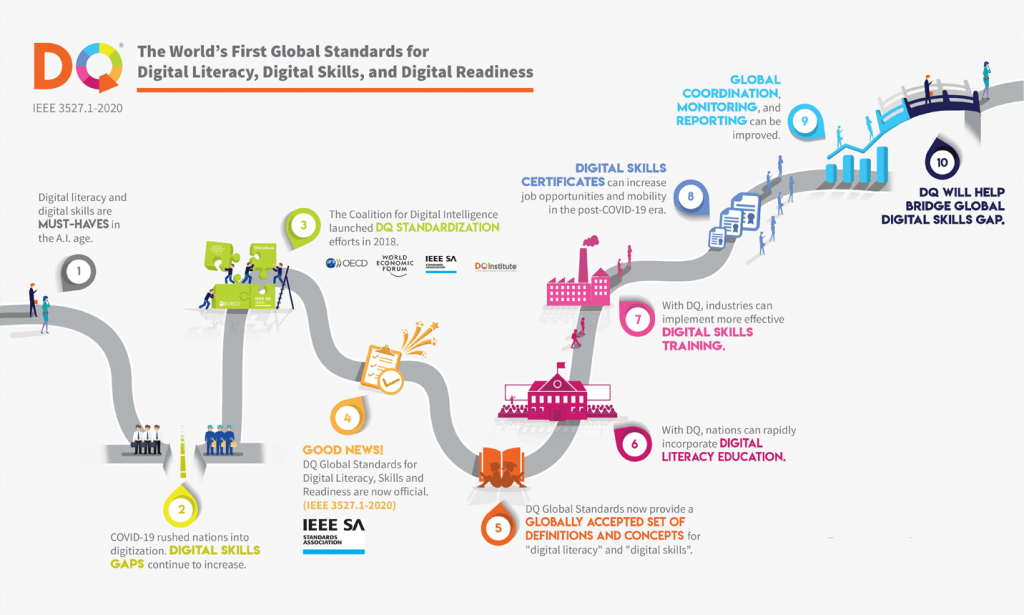
The Institute explains that 2020 was their biggest year yet, by constructing the DQ Global standards that are adaptable for all nations and sectors to adopt and integrate, initiating the new standard for global educational standards that all children can learn from, and riveted a “global measure for child online safety that all nations can take heed of.”
It was then on September 24th, 2020 where the IEEE SE gave official approval for the new DQ (Digital Intelligence) – more on that in a moment – creating “the world’s first global standard related to digital literacy, digital skills, and digital readiness.”
Additionally, a subsidiary to the DGI is the DQ Lab Pte Ltd was established, whose goal is to:
Provide global benchmarking tools of the DQ global standards through real-time data assessment and visualization that empower individuals, organizations, and nations to be digitally safe and competent. Its management is empowered to make decisions with a primary focus on furthering our mission while at the same time maximizing profits within the context of promoting the mission.
Digital Eugenics
So what exactly is the DQ? DQ stands for “Digital Intelligence.”
[DQ is defined as] a comprehensive set of technical, cognitive, meta-cognitive, and socio-emotional competencies that are grounded in universal moral values and that enable individuals to face the challenges and harness the opportunities of digital life.
Its framework aggregated across more than 25 prior leading frameworks about digital literacy and skills. It lays out a common language, structure, and taxonomy around digital literacy, skills, and readiness that can be benchmarked, referenced, and adopted across nations and sectors worldwide.
The DQ Institute’s self-explanation
The Institute places the DQ in the same identical category that of the Intelligence Quotient (IQ) and Emotional Quotient (EQ) tests. DQ, as explained further, is essentially a composite score based on a number of standards the Institute and other partnered groups have designed – similar to the other aforementioned psychology tests that you are fairly familiar with, merged with the conventional social credit score system .
To give a very brief and broad synopsis of the origins of the IQ test – it finds its origins from the Eugenic Society created in America. Eugenics are essentially the Darwinian theory of evolution on steroids. It was basically a think-tank of highly educated people who believed they were so smart they could determine who was allowed to be a part of society, who can marry whom and have children. Through a series of tests and examinations, if the person failed or finished with a low score, the society would deem that person not fit for society, labeling them as “stupid,” “imbeciles,” and “mentally retarded.” The society then would create certificates proving that “Billy” was adequate for marriage and future procreation.

In a simplified way, they believed that intelligence is hereditary and was passed on genealogically. Therefore, if you failed their tests, they perceived this to be a case of inheriting “bad” or “unwanted” genes. At its core, it was based upon Charles Darwin’s concepts of “natural selection” and “survival of the fittest,” where, through the process of time, the weaker traits and genes would die-off as the “stronger kind” survived and passed on their genes, which continually would evolve through time. Only in the case of eugenics, the selection process was controlled and forced, and not natural.
The society went so far as to forcibly sterilize people they felt were in danger of passing on their “bad genes” to future generations. These were the origins of what was called “euthanasia.” The Society was also incredibly racist, believing that the Blacks and Hispanics were the “dumbest” of them all, where as the majority of the Whites were far more superior – views that Charles Darwin himself believed, though are never found in a single science textbook today.
All of this occurred in America from the mid to late 1800’s and into the 1900’s. Eventually this same pseudo-science was taken up in Nazi Germany, to create an adequate super solider for the day, and more astute generations to keep the Reich alive and stronger than previously.
But the WEF believes that the IQ score has been rendered obsolete and the DQ is needed instead. The Forum wrote a post titled “Forget IQ. Digital intelligence will be what matters in the future.” The WEF expressed the world’s need to accept the DQ, writing:
But unlike IQ, which is commonly viewed as a genetically determined intelligence, DQ is something that needs to be built. It is a fundamental precursor to 21st-century skill development for the future workforce because, like a language, it is most effectively absorbed at a young age.
The world needs DQ. As the Fourth Industrial Revolution progresses and our lives become increasingly connected, the health and prosperity of societies the world over will depend on it.
DQ 24 And The Better Life Initiative
Going back to this new test, the DQI has developed “24 digital competencies,” that are separated into 8 different categories, with 3 primary levels of citizenship, creativity, and competitiveness, for that category. Each primary level is then explained in much greater detail, of knowledge, skills, and attitudes/values.
They are as follows:
- Digital Identity – the ability to build a wholesome online and offline identity.
- Digital Citizen Identity – The ability to build and manage a healthy identity as a digital citizen with integrity.
- Digital Co-Creator Identity – The ability to identify and develop oneself as a co-creator of the digital ecosystem.
- Digital Changemaker Identity – The ability to identify and develop oneself as a competent changemaker in the digital economy.
- Digital Use – the ability to use technology in a balanced, healthy, and civic way.
- Balanced Use of Technology – The ability to manage one’s life both online and offline in a balanced way by exercising self-control to manage screen time, multitasking, and one’s engagement with digital media and devices.
- Healthy Use of Technology – The ability to understand the benefits and harms of technology on one’s mental and physical health and to use technology use while prioritizing health and well-being.
- Civic Use of Technology – The ability to engage in civic participation for the well-being and growth of local, national, and global communities using technology.
- Digital Safety – the ability to understand, mitigate and manage various cyber-risks through safe, responsible, and ethical use of technology.
- Behavioral Cyber-Risk Management – The ability to identify, mitigate, and manage cyber risks (e.g., cyberbullying, harassment, and stalking) that relate to personal online behaviors.
- Content Cyber-Risk Management – The ability to identify, mitigate, and manage content cyber risks online (e.g., harmful user generated content, racist/hateful content, image-based abuse).
- Commercial and Community Cyber-Risk Management – The ability to understand, mitigate, and manage commercial or community cyber-risks online, which is an organizational attempt to exploit individuals financially and/or through ideological persuasion (e.g., embedded marketing, online propaganda, and gambling).
- Digital Security – the ability to detect, avoid, and manage different levels of cyber threats to protect data, devices, networks, and systems.
- Personal Cyber Security Management – The ability to detect cyber threats (e.g., hacking, scams, and malware) against personal data and device, and to use suitable security strategies and protection tools.
- Network Security Management – The ability to detect, avoid, and manage cyber-threats to cloud-based collaborative digital environments.
- Organizational Cyber Security Management – The ability to recognize, plan, and implement organizational cyber security defenses.
- Digital Emotional Intelligence – the ability to recognize, navigate, and express emotions in one’s digital intra and inter-personal interactions.
- Digital Empathy – The ability to be aware of, be sensitive to, and be supportive of one’s own and other’s feelings, needs and concerns online.
- Self-Awareness and Management – The ability to recognize and manage how one’s value system and digital competencies fits with one’s digital environment.
- Relationship Management – The ability to skillfully manage one’s online relationships through collaboration, conflict management, and persuasion.
- Digital Communication – the ability to communicate and collaborate with others using technology.
- Digital Footprint Management – The ability to understand the nature of digital footprints and their real-life consequences, to manage them responsibly, and to actively build a positive digital reputation.
- Online Communication and Collaboration – The ability to use technology effectively to communicate and collaborate collectively, including at a distance.
- Public and Mass Communication – The ability to communicate with an online audience effectively to exchange messages, ideas, and opinions reflecting wider business or societal discourses.
- Digital Literacy – the ability to find, read, evaluate, synthesize, create, adapt, and share information, media, and technology.
- Media and Information Literacy – The ability to find, organize, analyze, and evaluate media and information with critical reasoning.
- Content Creation and Computational Literacy – The ability to synthesize, create, and produce information, media, and technology in an innovative and creative manner.
- Data and AI Literacy – The ability to generate, process, analyze, present meaningful information from data and develop, use, and apply artificial intelligence (AI) and related algorithmic tools and strategies in order to guide informed, optimized, and contextually relevant decision-making processes.
- Digital Rights – the ability to understand and uphold human rights and legal rights when using digital technology.
- Privacy Management – The ability to handle with discretion all personal information shared online to protect one’s and others’ privacy.
- Intellectual Property Rights Management – The ability to understand and manage intellectual property rights (e.g., copyrights, trademarks, and patents) when using and creating content and technology.
- Participatory Rights Management – The ability to understand and exercise one’s powers and right to online participation (e.g., their rights to personal data protection, freedom of expression, or to be forgotten).
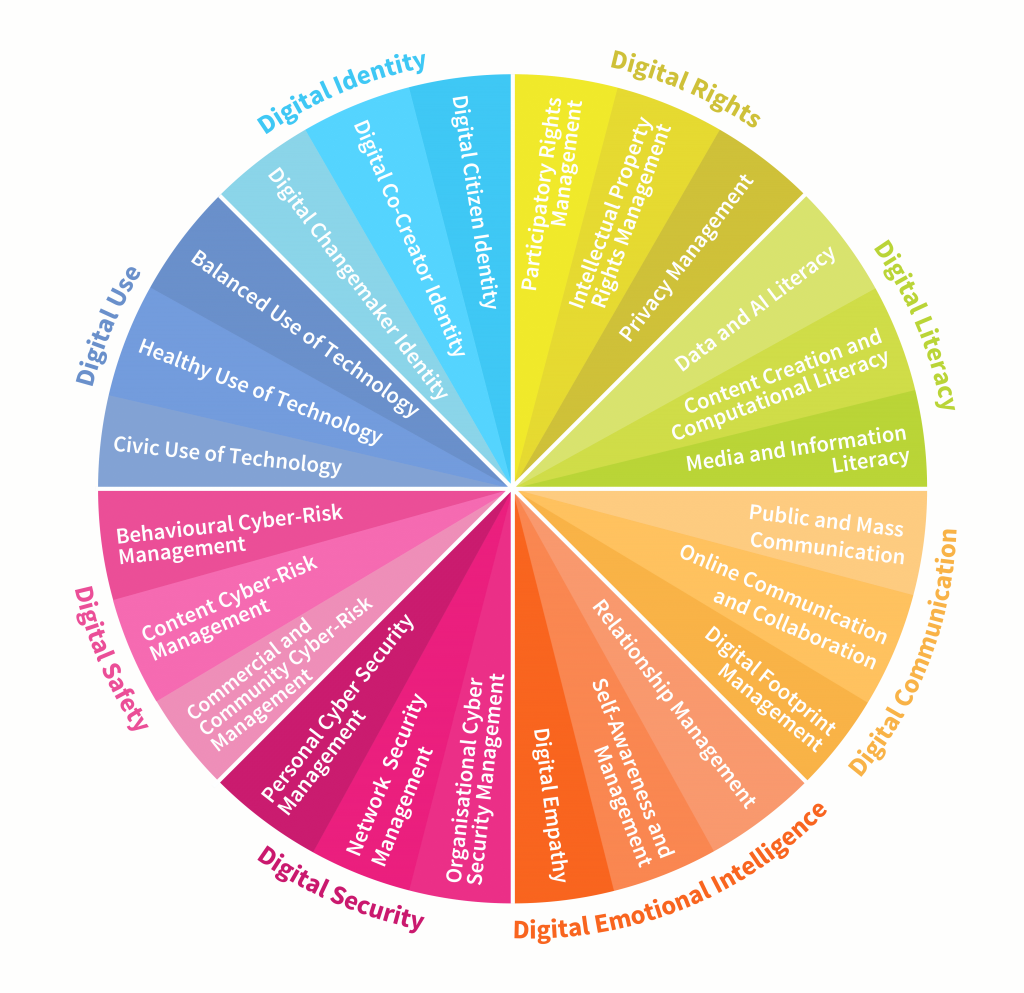
Each primary level is color-coded with a variety of different dots representing the different companies and organizations that are helping with that specific group, demonstrating just how deeply involved international companies are with implementing the DQ.
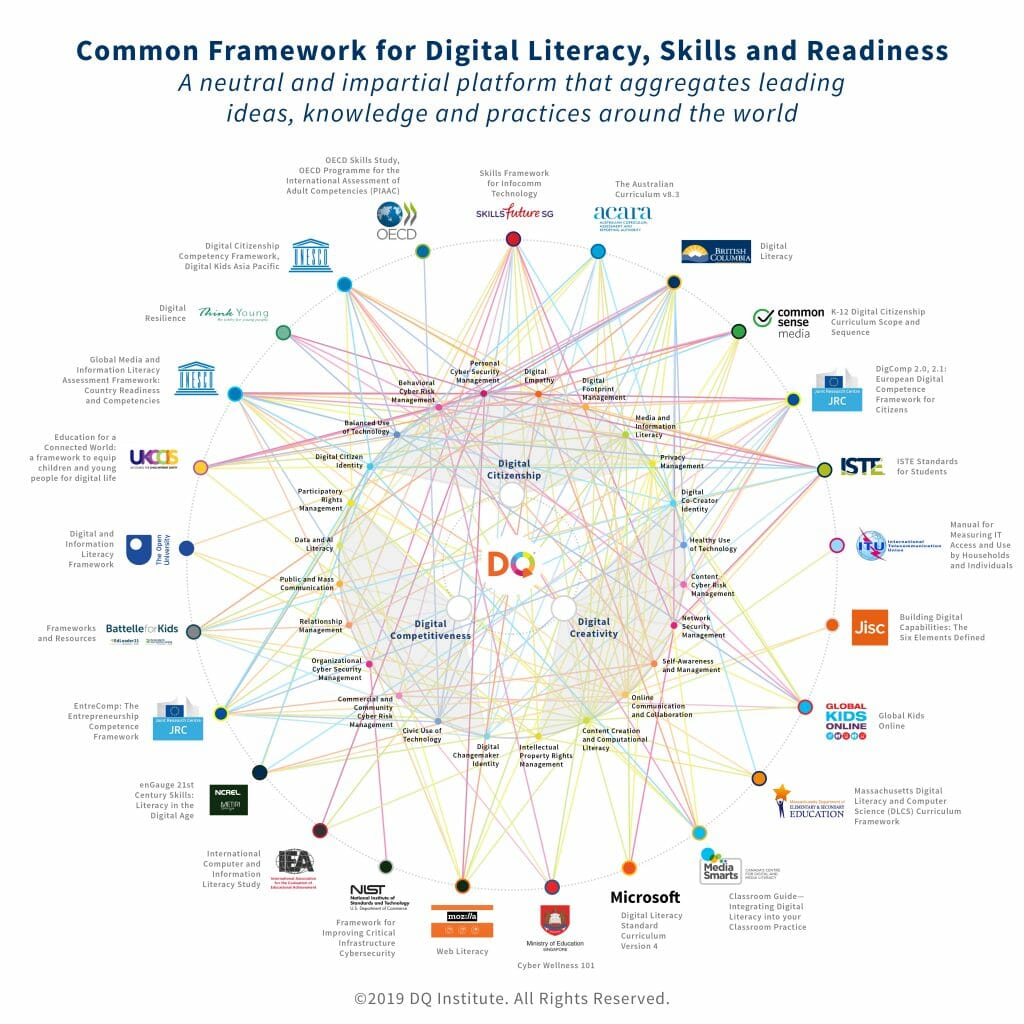
From there, the standards breakdown even further yet again.
The Institute then introduces what they call “DQ Micro-Badges:”
The DQ Micro-Badge (DQ MB) system is a list of the micro-certifications of the DQ Global Standards (IEEETM 3527.1). Each of the DQ24 competencies has multiple constituent facets, represented by micro-badges. The DQ MB helps users to discover which digital skills topics within the DQ Global Standards they will need to obtain through education/training programs, and understand how these programs will enhance specific job readiness skills and overall well-being.
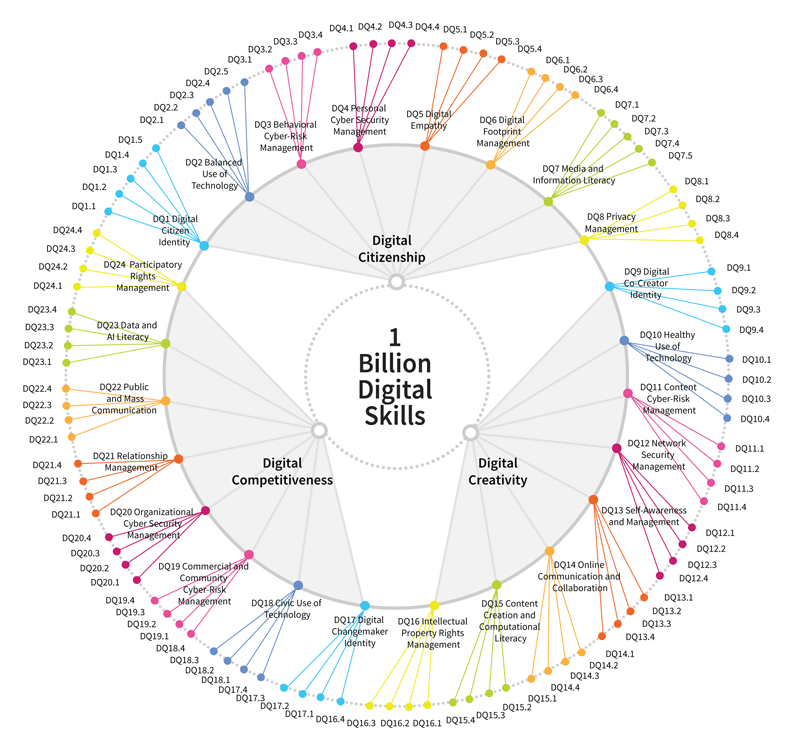
These micro-badges are listed under the 8 different categorical skill sets for “Digital Citizenship.” Each micro-badge has its own description of what is required to earn that badge. Along with that comes a ranking system of “basic,” “intermediate,” and “advanced” future-readiness skills.
Here are just a few of those badges:
DQ1.5 Global Digital Citizenship – You understand that you are a global citizen in the digital world that transcends physical boundaries. You have global awareness and netiquette while being socially and emotionally aware and being open to understanding different views with cultural sensitivity online.
DQ2.2 Health Check – Tech Addiction – You do not show the symptoms of technology addiction (e.g., gaming disorder or social media disorder).
DQ5.3. Perspective Taking – You are capable of considering the different perspectives of others and exercising the Golden Rule – “do to others as you want to be treated” in online interactions.
DQ6.2 Digital Footprints Impact – You know your digital footprints can be permanent, tracked, collected, and go viral, even against your will. You understand that your digital footprints can affect your reputation in real life.
DQ6.5. Digital Footprint Impacts (Company) – You understand that your online activities using your company’s IT infrastructure can be traceable and your digital footprints can shape and affect your company’s reputation. You do not conduct personal online activities or risky behavior on company computers and networks.
DQ6.6. Mitigating Social Media Crises (Company) – You know what to share and what not to share in a professional context, while being able to identify online information that can affect your company’s reputation. When you encounter negative digital footprints for your company, you know and follow company policies to deal with them to effectively mitigate potential social media crises.
DQ7.2 Digital Information Evaluation – You are able to critically evaluate digital information (e.g., media content, news, video, etc.) by examining reliability and credibility to discern dis-/mis-information. You know how digital information is created on online platforms, how the use of digital information influences to construct knowledge and public opinion, and how digital information can be potentially misused.
DQ7.4 Health Check – Risky Content and Contact – You have not been actively involved in nor intend to be involved with risky content (e.g., violence, sexual, hatred, or unwanted content) and risky contacts (e.g., online grooming, extremists, unwanted sexual contact) online.
DQ8.3 Privacy Attitudes – You care about your own and others’ privacy online. While having critical eyes on privacy options provided by technology platforms, you are willing to take steps to protect your own and others’ personal information.
Furthermore, these various micro-badges then correlate with “Future-Readiness Skills:”
The following 12 skills are commonly identified as important future-readiness skills for individuals to obtain in order to achieve their life well-being as well as their career development based various reports and literatures developed by the international organizations (e.g. OECD, the World Economic Forum), the private sectors (e.g. Accenture, Mckinsey), and the civic sectors (e.g. Ashoka).
Even though we agree with these frameworks for future-readiness, it may still get clearer to individuals or trainers about HOW to build these skills.
The DQ MB System, taken together, will develop many of the building blocks underlying all of these skills. We start with the level of Digital Citizenship (DQ1-8). This table provides a guide to understanding how DQ MBs (Digital Citizenship) are related to Future-Readiness Skills.
These 12 skills are then given “Related Skills Defined by Landing Frameworks” – the standards defined by these partnering and contributing groups – and corresponding DQ MBs. They are:
- Analytical Thinking
- Critical Thinking
- Organizational Skills
- Technological Skills
- Problem Solving
- Creativity
- Initiative
- Communication
- Adaptability
- Resilience
- Social and Emotional skills
- Leadership
But it doesn’t stop there. All of this culminates to the “ultimate goal” of the DQI:
The ultimate goal of the DQ Framework is to guide digital practices towards achieving individual and societal well-being across all aspects of one’s life.
The OECD’s Better Life Initiative identified the following 11 areas of well-being: income, wealth, jobs, earnings, housing, quality of life, including health, civic engagement, social connections, education, security, life satisfaction, and the environment. These 11 areas of well-being, in turn, contribute to achieving the 17 UN Sustainable Development Goals (UN SDGs).
The UN SDGs focus on 17 societal dimensions, including ending poverty and promoting prosperity, well-being, and protection of the planet.
With the goal of advancing the UN SDGs, we adopted the OECD’s 11 indicators of well-being as a guide for pinpointing areas where interventions can be made to equip individuals with digital intelligence.
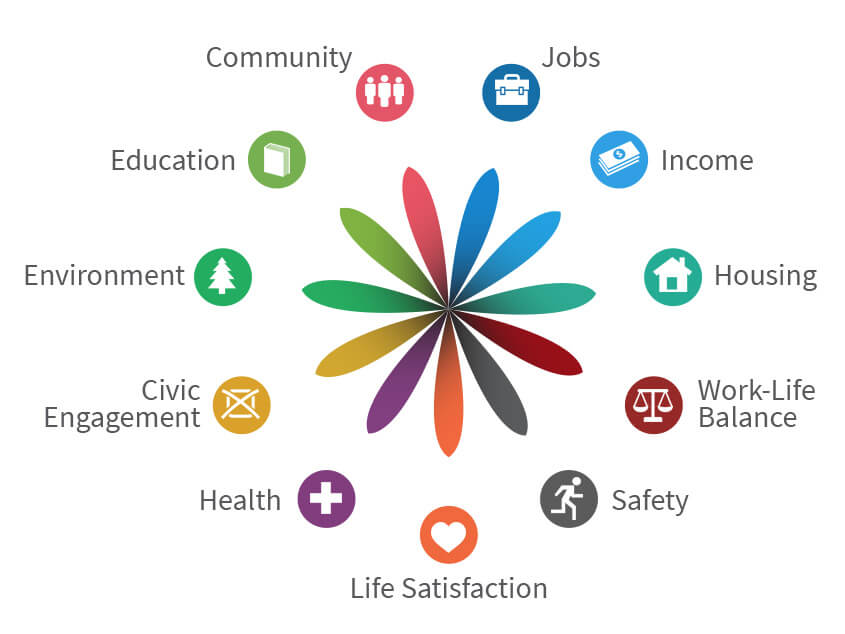
These developmental goals are then correlated with OECD’s Well-Being Indicators (Income, Health, Education, Housing, Environment, Jobs, Life Satisfaction, Civic Engagement, Environment, Safety, and Community), and aligned with the DQ Competencies: the UN goals rewritten.
Finally, the DQI have standards for parental involvement and guidance for their children:
PM1: Family Media Boundary – Parents have clear family tech rules and principles to provide children proper protection and guidance.
PM2: Parental Engagement – Parents engage in open and supportive active mediation to minimize negative effects and maximize positive effects of media use. Parents can nurture family values in children through technology, support children’s social and emotional growth, and empower them to make the right choices online.
PM3: Family Network – Parents set a healthy digital environment for children – from connectivity, support network to seeking help as needed based on knowledge on tech trends and their impact on children.Please remember that digital parenting is not about parents having control over their teens’ technology use, rather it is about parents empowering their teens to be good digital citizens who can minimize risks and maximize potentials in the digital world.
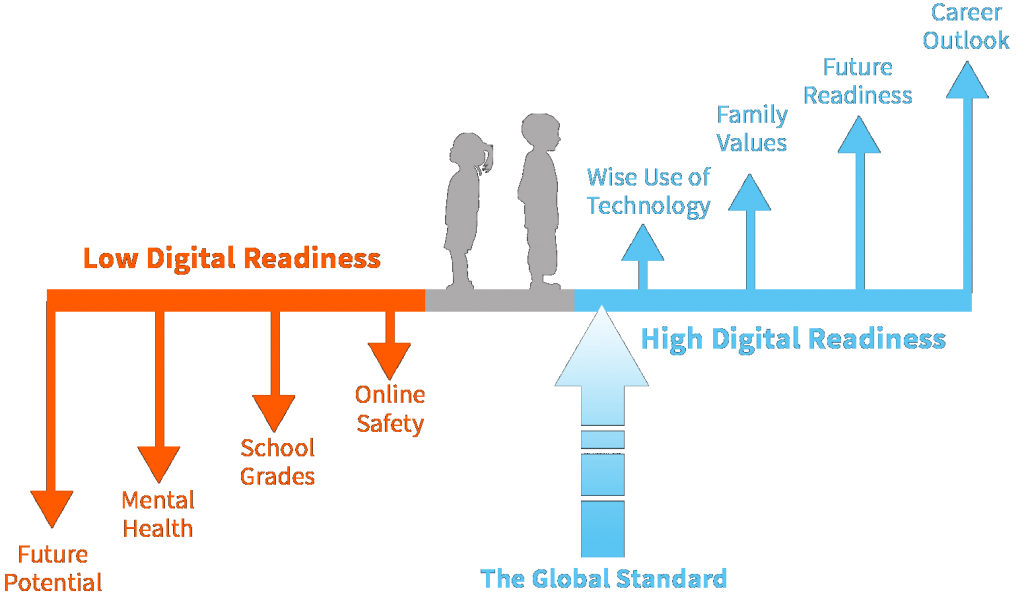
The DQ Score
So what in the world do all these standards translate to? Well, similar to an IQ test and social credit score, all these skills and standards are then composited into a number that represents an individual’s overall digital intelligence.
This is where the “DQ Assessment and Analytics Tool (DQ Assessment)” comes into play – an interactive software and data collection tool that can be used in homes, schools, and workplaces; mirroring the general framework of China’s social credit score system.
All the data collected from the DQ Assessment is included in the Global DQ Databank that produces the DQ Index, and in the impact measure of specific digital skills initiatives, as well as an aggregated index that measures the level of digital intelligence (DQ) competencies of nations.
The goal of the DQ Index is to monitor the global progress in building digital skills inclusively worldwide with the aim of empowering every individual and organization in each nation to be digitally ready – safe, ethical, and competent.
The DQ Index tangibly helps multi-stakeholder leaders visualize and implement how they ensure individuals’ and organizational capacity building of digital skills in their sphere of influence through its practical DQ assessment tools.
The DQ Assessment utilizes the preestablished benchmarks and standards to analyze “levels of multiple competencies of digital intelligence of individuals and organizations,” compared to the rest of the world’s performance based on the same criterium – allows individuals and organizations to pinpoint strengths and deficiencies based on the global standards, and digital skill augmentation for individuals and organizations that are customized to aid in lifelong training.
These “instruments” have been designed and curated by numerous “credible sources and existing research projects of content owner partners.”
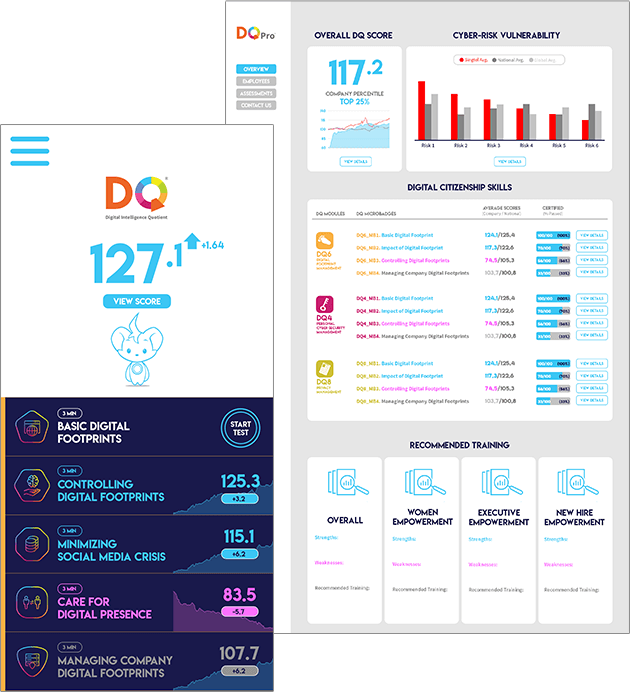
From this real-time data collection, out pops an overall score, just like the IQ test. This is called the DQ Score.
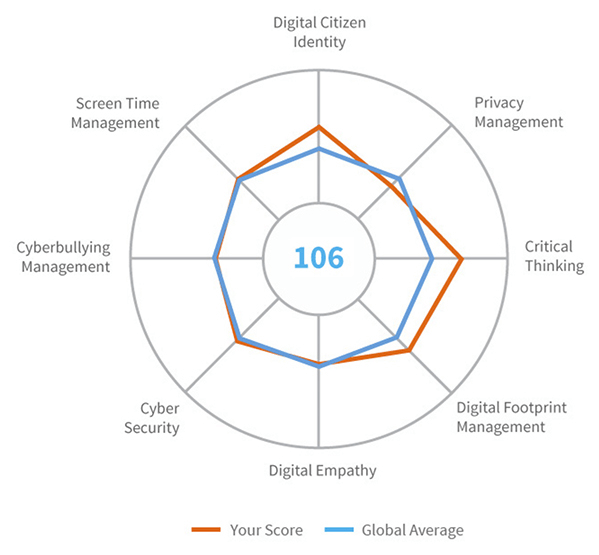
DQ Score is a composite number derived from the competence levels measured according to the eight core digital citizenship competencies. Similar to an IQ score, the global average is 100, with the standard deviation of 15.
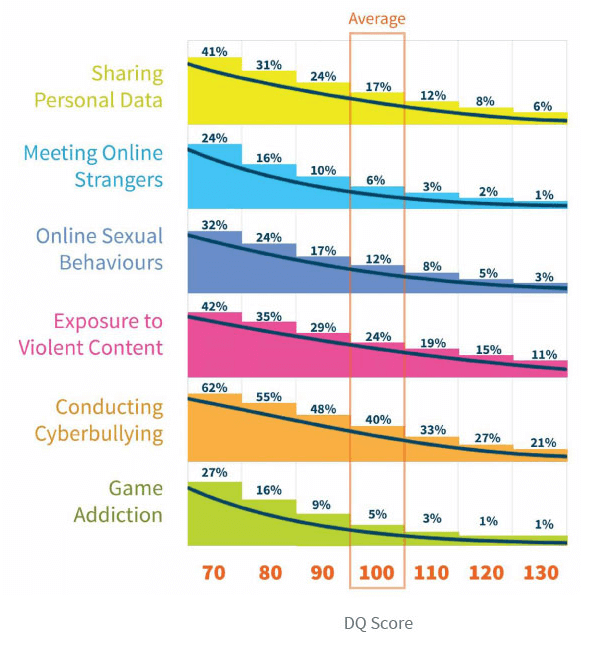
DQ Score correlates significantly with the level of cyber-risks (inverse) and personal strengths (direct).
For example, on average a DQ Score of 90 for sharing personal data translates to a 24 percent risk of a child sharing personal data. However, increasing their DQ score to 100 reduces that risk to 17 percent, and raising their score to 110 further reduces it to 12 percent.
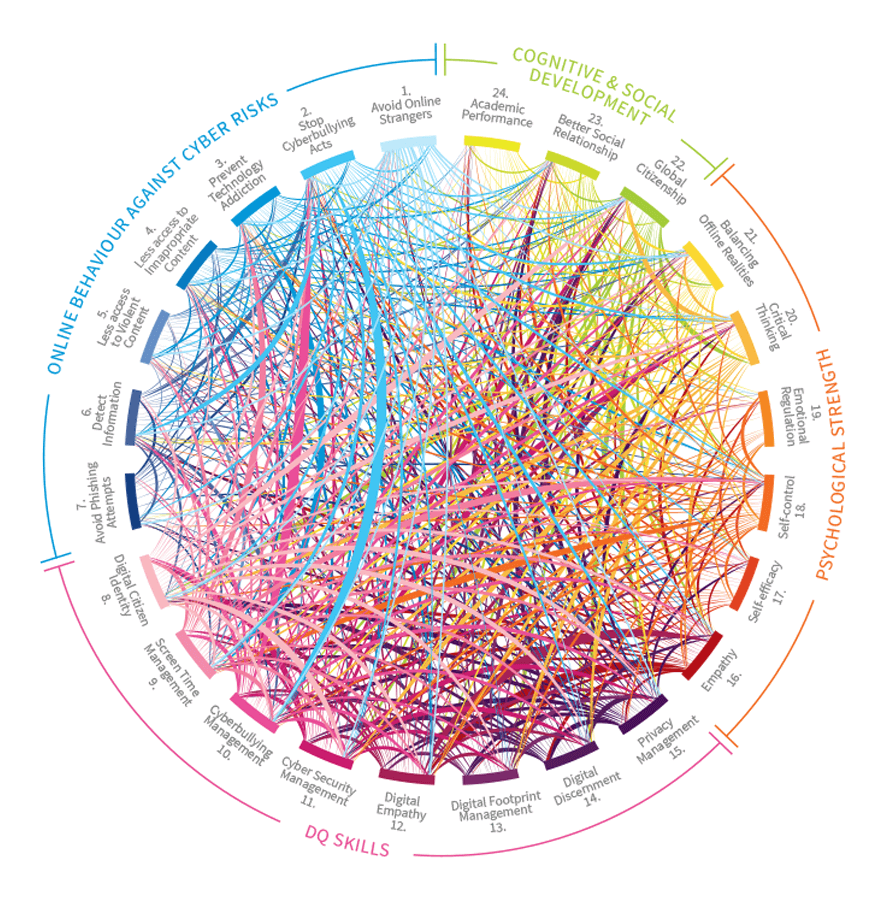
With this implementation of this new score, the DQI and other partnered groups strive to further a “International Collaborative Project” for child safety and digital citizenship.
DQI notes that children are forced to grow up in a “strange new world,” schools have been forced to close and move almost if not completely online, and children spending all their time glued and addicted to a screen. Already having to deal and navigate the aforementioned cyber-risks, the major shift that began in 2020 with the start of the lockdowns and isolation have caused health issues in children to spike, along with these cyber-risks dramatically increasing. This all leads to, as they assert, poorer social adjustment, school performance, and health.
According to DQI, there are already a handful of international and national-level institutions with identical goals, but the DQI and it’s partners seek to improve on them all at an accelerated rate – that is exceedingly more efficient and coordinated – on a global level.
In their own words, DQI strives to foster:
A common measurement and global databank to monitor global, national, and local progress on child online safety and digital citizenship. The measurement being developed in this Project can be integrated together with other indices that measure digital economy performance, such as the G20 Measurement for Digital Economy, and digital sustainability, such as the UN Sustainable Development Goals.
National Rankings And Frameworks
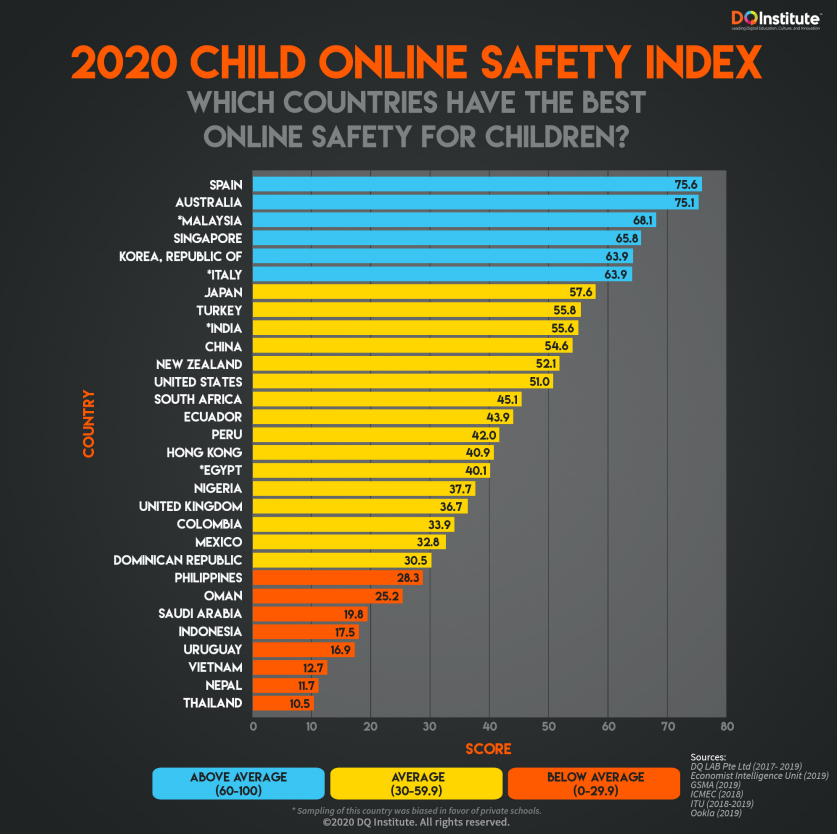
In 2020 the first global real-time measure of children’s online safety status was launched, called the The Child Online Safety Index (COSI). The data was compiled from over 145,400 youth, amassed from young children and teens from 30 countries in 2017 through 2019.
COSI analyzes its global database along with the DQ Assessment standards, and automatically updates a nation’s current score.
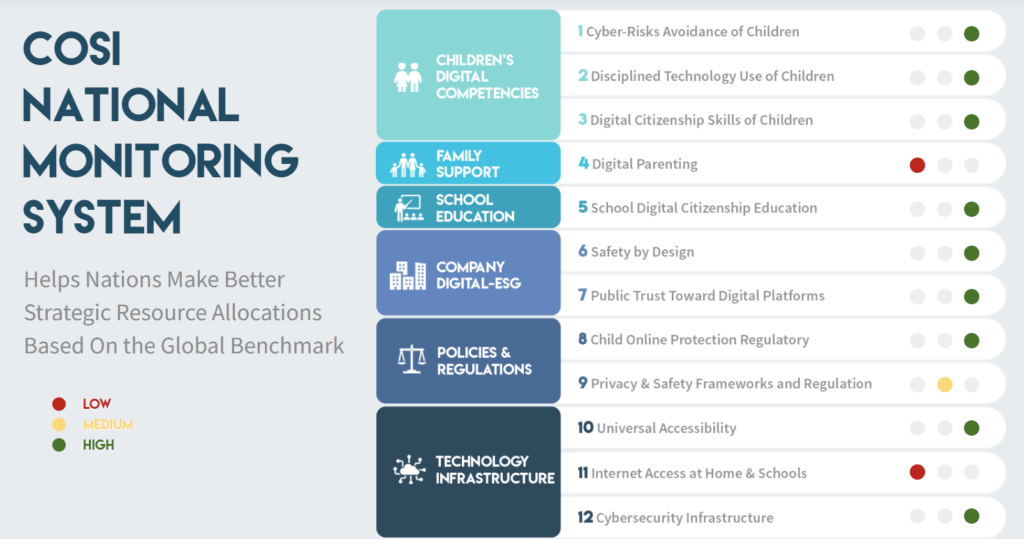
The framework is patterned after a pillared building, with the foundation of 24 areas of analysis, supported by 6 pillars (Cyber Risks, Disciplined Digital Use, Digital Competency, Guidance and Education, Social Infrastructure, and Connectivity), supporting three primary constructs of “Wise Use, Empowerment, and Infrastructure.”
The Child Online Safety Index (COSI) measures the level of online safety for children across the world based on six pillars: Cyber Risks, Disciplined Digital Use, Digital Competency, Guidance & Education, Social Infrastructure, and Connectivity. Each of these pillars are formed by 2-8 focused areas, allowing for a comprehensive assessment of online safety for children. A COSI score was calculated for each country ranging from 0 (the worst online safety for children) to 100 (the best online safety for children).
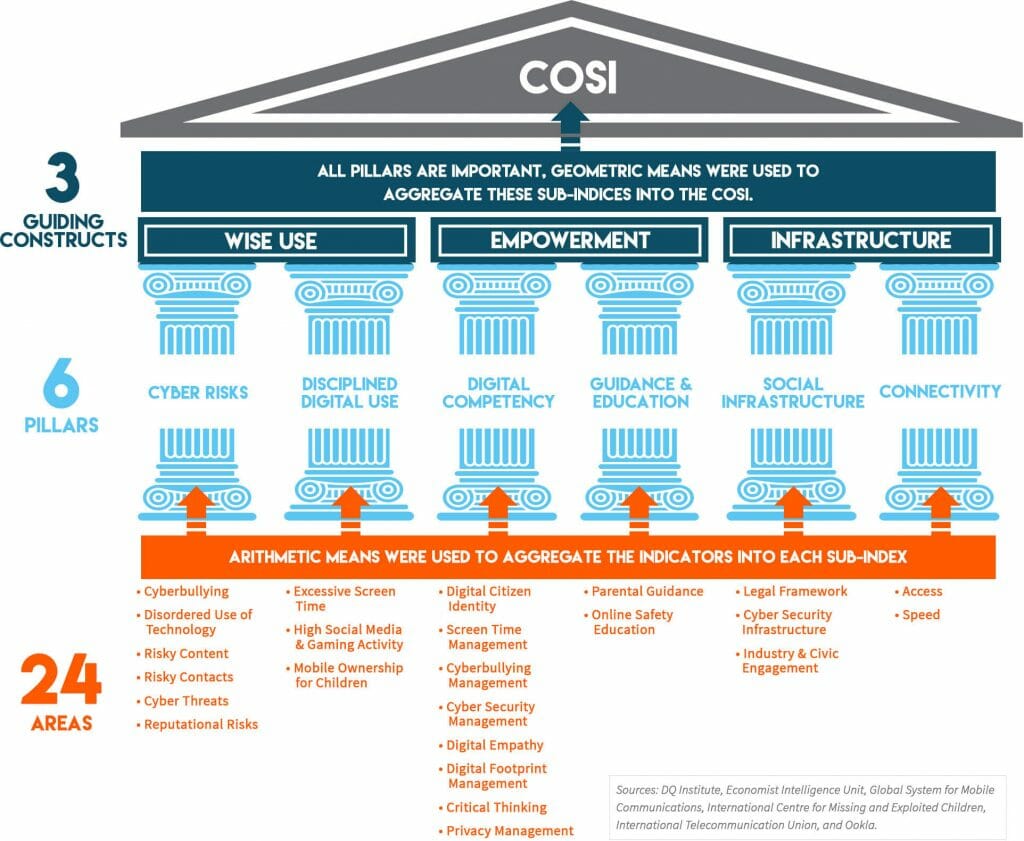
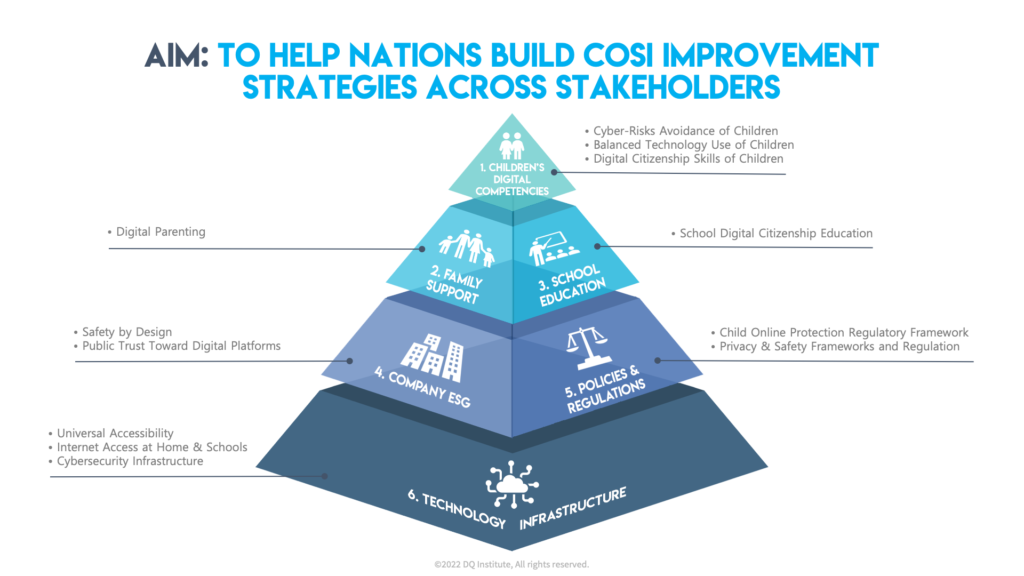
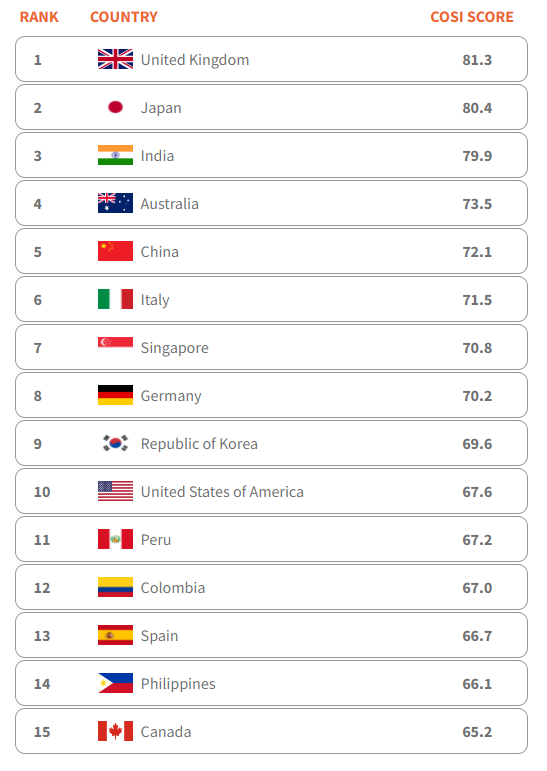
In 2022 the United States, for example, ranked 10th of 100 with a score of 67.6.
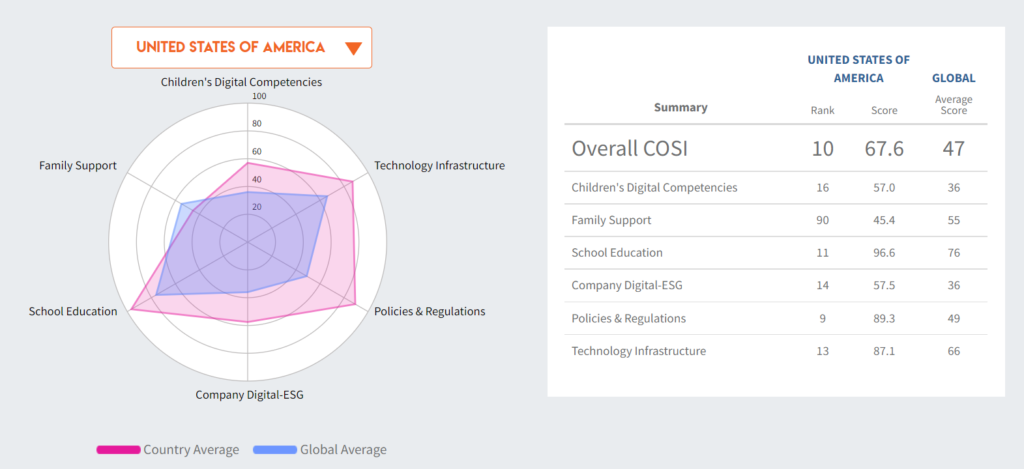
Interestingly enough, the DQI says the U.S. has a ‘low’ level of “Internet access at home & schools.”
Currently the United Kingdom is in first (81.3), Japan in a close second (80.4), and India taking the bronze (79.9).
The results have changed since the COSI’s release in 2020.
No Child Left Behind
The Institute had additionally launched the #DQEveryChild movement, targeting 8-12 year-olds, as a “Global Digital Citizenship Movement.”
#DQEveryChild is a strategic global movement to empower 8-12 year olds with comprehensive digital citizenship skills from the start of their digital lives. The movement started in collaboration with Singtel and the World Economic Forum, and has quickly expanded to include over 100 partner organizations and was active in more than 80 countries in 2019.
The eLearning kit includes an 8-day course for children to learn the 8 Digital Citizenship Skills. As the children complete the course, parents are given a scorecard with their DQ ranking and thorough breakdown of their deficiencies and achievements. Parents are then given an official handbook on how to help improve their children’s DQ.
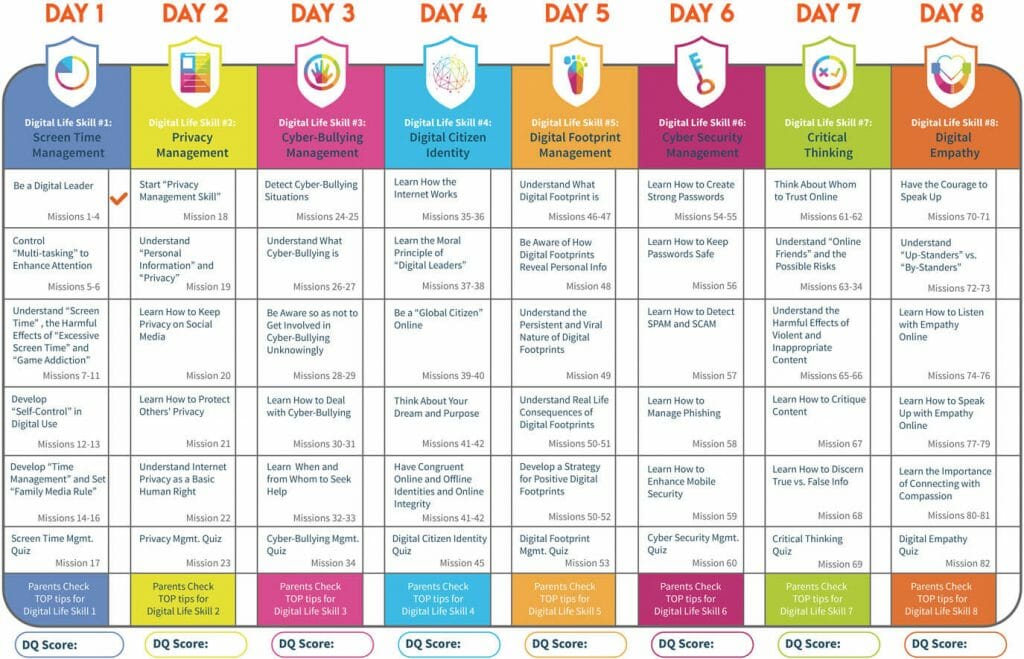
The DQI produced a video explaining the program in more depth. As children complete the courses online and behind a screen, they will play games, read comic books, make stickers, and message others in a globally interactive chatroom mimicking social media platforms such as Facebook or Twitter. Just like the Scouts, children will earn badges for their achievements, along with earning digital coins and digital trading cards.
In December of 2021 the DQI and other groups partnered with eSmart Digital Licence+, a new Digital Intelligence capacity development program for teens in Australia and New Zealand, to insert the DQ philosophy onto select students.
This tripartite partnership demonstrates how like-minded international partners can work together and bring high quality digital literacy education programs to students. Powered by the DQ Global Standard, eSmart Digital Licence+ is a leading Digital Intelligence program with impact tracking based on the global benchmark.
Yuhyun Park said in a statement, reported by Yahoo
Global Internet Crackdown
While the WEF continues to promote the digital quotient – as can be seen in an article published yesterday, January 11th – nations and social media websites have begun to really crackdown on what people can and cannot say online.
The WEF, of course, is for this type of suppression, as can be evidenced by their “Press Freedom” panel calling for additional investments to be made in squashing smaller and independent outlets. And only a few months later the Forum also floated out the idea of merging artificial and human intelligence together to censor ‘misinformation’ and ‘hate speech,’ claiming that both parties on their own are not sufficient enough to mitigate what is posted online, but a symbiotic relationship between the two would be ideal to get rid of people and views they claim to be “dis-” and “misinformation.”
But the WEF are certainly not the only ones calling for and enacting internet censorship.
Authorities in Saudi Arabia are already using a Google app to track and spy on their own citizens who would dare to criticize the government, which could result in life sentences in prison. Meanwhile in Europe non-government organizations (NGOs) are urging residents to snitch on each other by reporting transgressor’s “digital violence” and hate speech via an app.
Last year The WinePress detailed a document published by New Zealand’s Kiwi Secret Service (NZSIS), urging citizens to tattle on those who they think are “terrorists” and disagree with the government; with the Director-General saying, “it could be the Covid measures that the Government took, or it could be other policies that are interpreted as infringing on rights and it’s a kind of what I describe as a hot mess of ideologies and beliefs fueled by conspiracy theories.”
More recently Australian federal police have publicly asked civilians to report on each other if they speak of “Anti-Government, Anti-Police, Or Covid Vaccine Conspiracy Theorists.” A day prior to that announcement, The WP reported on December 28th the Australian government talked about implementing a “Social Media Passport” To Crackdown On ‘Online Abuse’ And ‘Bad Behavior,’ a lukewarm social credit score and digital ID in order to actually gain access to certain certain and social media platforms.
Bearing all these moves in mind, and what the DQ Institute and WEF claims to stand for, it is not too far of a stretch for this to perhaps be implemented on a much broader scale than it currently is, and not just primarily for children.
Even if it is not the DQI, for the sake of argument, the company has certainly laid-out a solid framework for what a broader internet social credit score could operate as.
At the very least the DQ will serve as a platform to prime the youth to behave the WEF and other globalists what them to think and behave, and get them used to the idea of a social credit score.
AUTHOR COMMENTARY
Surely oppression maketh a wise man mad; and a gift destroyeth the heart.
Ecclesiastes 7:7
To my knowledge I don’t know if there is really anyone else talking about this, so I wanted to really shed some light on this, as I really think this is a dark horse that very few know about and understand, and what it could potentially evolve into, considering what we know about the WEF as is.
But this brainwashing is classic Nazi-fascism at its [not-so] finest.
In relation to the political decontamination of our public life, the government will embark upon a systematic campaign to restore the nation’s moral and material health. The whole educational system, theatre, film, literature, the press and broadcasting – all these will be used as a means to this end.
Adolf Hitler once said
Moreover, the DQI fits the bill for what fascism means and stands for at its core:
Fascism should rightly be called corporatism because it is a merger of state and corporate power.
Benito Mussolini
The DQ Institute is precisely fascism: world governments colluding with multinational corporations dictating what children and the masses must think and do. Hitler would be crying tears of joy if he had access to this level of control and manipulation.
And as I pointed out, even though the marketing is mostly geared to children, the Young Global Leader and her Institute confesses that it can also be integrated for businesses and homes, which just screams of social credit scores to me. You must take into account that fact that DQI is following the 17 UN Sustainability Goals, so that means they will be pushing radical climate activism, no meat, more bugs; everything electric, embrace AI, digital everything; live in deep penury to elevate other nations (grand communism); the end of private ownership of everything; reduced travel; and on and on.
But let me know your thoughts on this in the comment section, and let’s try to get the word out about this wicked agenda.
And the people shall be oppressed, every one by another, and every one by his neighbour: the child shall behave himself proudly against the ancient, and the base against the honourable.
Isaiah 3:5
[7] Who goeth a warfare any time at his own charges? who planteth a vineyard, and eateth not of the fruit thereof? or who feedeth a flock, and eateth not of the milk of the flock? [8] Say I these things as a man? or saith not the law the same also? [9] For it is written in the law of Moses, Thou shalt not muzzle the mouth of the ox that treadeth out the corn. Doth God take care for oxen? [10] Or saith he it altogether for our sakes? For our sakes, no doubt, this is written: that he that ploweth should plow in hope; and that he that thresheth in hope should be partaker of his hope. (1 Corinthians 9:7-10).
The WinePress needs your support! If God has laid it on your heart to want to contribute, please prayerfully consider donating to this ministry. If you cannot gift a monetary donation, then please donate your fervent prayers to keep this ministry going! Thank you and may God bless you.





Hi there, I found your site by means of Google whilst searching for a similar subject, your site got here up, it looks good. I’ve bookmarked it in my google bookmarks.
I loved as much as you’ll receive carried out right here. The cartoon is attractive, your authored subject matter stylish. nevertheless, you command get bought an shakiness over that you would like be handing over the following. in poor health certainly come more in the past once more as precisely the same just about very frequently inside case you defend this increase.
naturally like your website but you have to check the spelling on several of your posts. Many of them are rife with spelling issues and I in finding it very bothersome to inform the truth however I’ll definitely come back again.
I’ve read several excellent stuff here. Certainly price bookmarking for revisiting. I wonder how much attempt you put to make such a great informative web site.
I was reading some of your posts on this website and I conceive this site is really informative! Continue posting.
You could certainly see your enthusiasm within the work you write. The sector hopes for more passionate writers like you who aren’t afraid to mention how they believe. Always follow your heart.
I think that is one of the most vital information for me. And i am happy reading your article. But should commentary on few basic issues, The web site taste is perfect, the articles is really nice : D. Good job, cheers
Some really interesting info , well written and loosely user genial.
Terrific work! This is the type of information that should be shared around the net. Shame on Google for not positioning this post higher! Come on over and visit my site . Thanks =)
Excellent read, I just passed this onto a colleague who was doing a little research on that. And he actually bought me lunch since I found it for him smile Thus let me rephrase that: Thank you for lunch! “Any man would be forsworn to gain a kingdom.” by Roger Zelazny.
Can I just say what a reduction to seek out someone who actually is aware of what theyre speaking about on the internet. You undoubtedly know how you can carry a problem to mild and make it important. More individuals must read this and understand this facet of the story. I cant believe youre not more common because you positively have the gift.
Thank you, I have recently been looking for info about this subject for ages and yours is the greatest I have discovered so far. But, what about the bottom line? Are you sure about the source?
Hi my friend! I wish to say that this article is amazing, nice written and include almost all important infos. I would like to see more posts like this.
Glad to be one of many visitors on this awful site : D.
Do you have a spam issue on this website; I also am a blogger, and I was wondering your situation; many of us have developed some nice procedures and we are looking to trade methods with others, be sure to shoot me an e-mail if interested.
Sweet website , super pattern, very clean and use pleasant.
I¦ve read several good stuff here. Certainly price bookmarking for revisiting. I surprise how much attempt you put to make one of these magnificent informative website.
Hello! I just wanted to ask if you ever have any problems with hackers? My last blog (wordpress) was hacked and I ended up losing many months of hard work due to no back up. Do you have any methods to stop hackers?
The other day, while I was at work, my cousin stole my apple ipad and tested to see if it can survive a forty foot drop, just so she can be a youtube sensation. My iPad is now broken and she has 83 views. I know this is entirely off topic but I had to share it with someone!
Admiring the commitment you put into your website and in depth information you provide. It’s great to come across a blog every once in a while that isn’t the same out of date rehashed material. Fantastic read! I’ve saved your site and I’m including your RSS feeds to my Google account.
I am glad to be one of several visitors on this outstanding web site (:, thanks for putting up.
Write more, thats all I have to say. Literally, it seems as though you relied on the video to make your point. You clearly know what youre talking about, why waste your intelligence on just posting videos to your site when you could be giving us something informative to read?
I really like your writing style, good information, thanks for posting : D.
This web site is really a walk-through for all of the info you wanted about this and didn’t know who to ask. Glimpse here, and you’ll definitely discover it.
Simply a smiling visitor here to share the love (:, btw great style.
Great tremendous things here. I am very satisfied to see your post. Thanks so much and i’m looking forward to contact you. Will you kindly drop me a e-mail?
Great post. I was checking constantly this blog and I am impressed! Very useful info specifically the last part 🙂 I care for such info a lot. I was seeking this certain information for a long time. Thank you and best of luck.
Way cool, some valid points! I appreciate you making this article available, the rest of the site is also high quality. Have a fun.
whoah this blog is great i love studying your posts. Keep up the great paintings! You already know, lots of persons are searching around for this information, you could help them greatly.
Hi there! Do you know if they make any plugins to safeguard against hackers? I’m kinda paranoid about losing everything I’ve worked hard on. Any tips?
You can definitely see your expertise in the work you write. The world hopes for more passionate writers like you who are not afraid to say how they believe. Always go after your heart.
Good – I should certainly pronounce, impressed with your website. I had no trouble navigating through all tabs and related info ended up being truly simple to do to access. I recently found what I hoped for before you know it in the least. Reasonably unusual. Is likely to appreciate it for those who add forums or anything, website theme . a tones way for your customer to communicate. Excellent task.
I truly appreciate this post. I’ve been looking all over for this! Thank goodness I found it on Bing. You have made my day! Thanks again
Thanks , I’ve recently been searching for information about this subject for a long time and yours is the greatest I have came upon so far. But, what about the bottom line? Are you positive in regards to the supply?
wonderful post, very informative. I wonder why the other specialists of this sector don’t notice this. You must continue your writing. I am sure, you’ve a great readers’ base already!
Hi would you mind letting me know which webhost you’re working with? I’ve loaded your blog in 3 completely different internet browsers and I must say this blog loads a lot quicker then most. Can you recommend a good hosting provider at a fair price? Many thanks, I appreciate it!
Wonderful goods from you, man. I have understand your stuff previous to and you are just extremely magnificent. I really like what you’ve acquired here, really like what you are stating and the way in which you say it. You make it enjoyable and you still care for to keep it smart. I cant wait to read much more from you. This is actually a great site.
We’re a gaggle of volunteers and opening a new scheme in our community. Your site provided us with useful information to work on. You’ve done a formidable task and our entire group will be grateful to you.
Some genuinely rattling work on behalf of the owner of this internet site, perfectly great subject matter.
The Pink Salt Trick is a minimalist but effective morning routine: Just drink a glass of lukewarm water mixed with a pinch of Himalayan pink salt as soon as you wake up.
Some truly nice and useful information on this internet site, likewise I think the pattern holds great features.
The Pink Salt Trick is a minimalist but effective morning routine: Just drink a glass of lukewarm water mixed with a pinch of Himalayan pink salt as soon as you wake up.
Hi there! Would you mind if I share your blog with my myspace group? There’s a lot of people that I think would really enjoy your content. Please let me know. Thank you
I enjoy what you guys are usually up too. This sort of clever work and coverage! Keep up the terrific works guys I’ve you guys to our blogroll.
I like the helpful information you supply to your articles. I’ll bookmark your weblog and check again here frequently. I am slightly sure I’ll be told lots of new stuff right right here! Good luck for the following!
I’ve recently started a site, the info you offer on this website has helped me tremendously. Thank you for all of your time & work.
I have not checked in here for some time as I thought it was getting boring, but the last few posts are great quality so I guess I’ll add you back to my daily bloglist. You deserve it my friend 🙂
Very interesting points you have mentioned, thanks for putting up. “The judge is condemned when the criminal is absolved.” by Publilius Syrus.
so much excellent information on here, : D.
When I originally commented I clicked the “Notify me when new comments are added” checkbox and now each time a comment is added I get several emails with the same comment. Is there any way you can remove me from that service? Bless you!